Safety data sheets under the scrutiny of European inspectors – lessons for Serbian companies
07/06/2026 | By Ivan Milenković
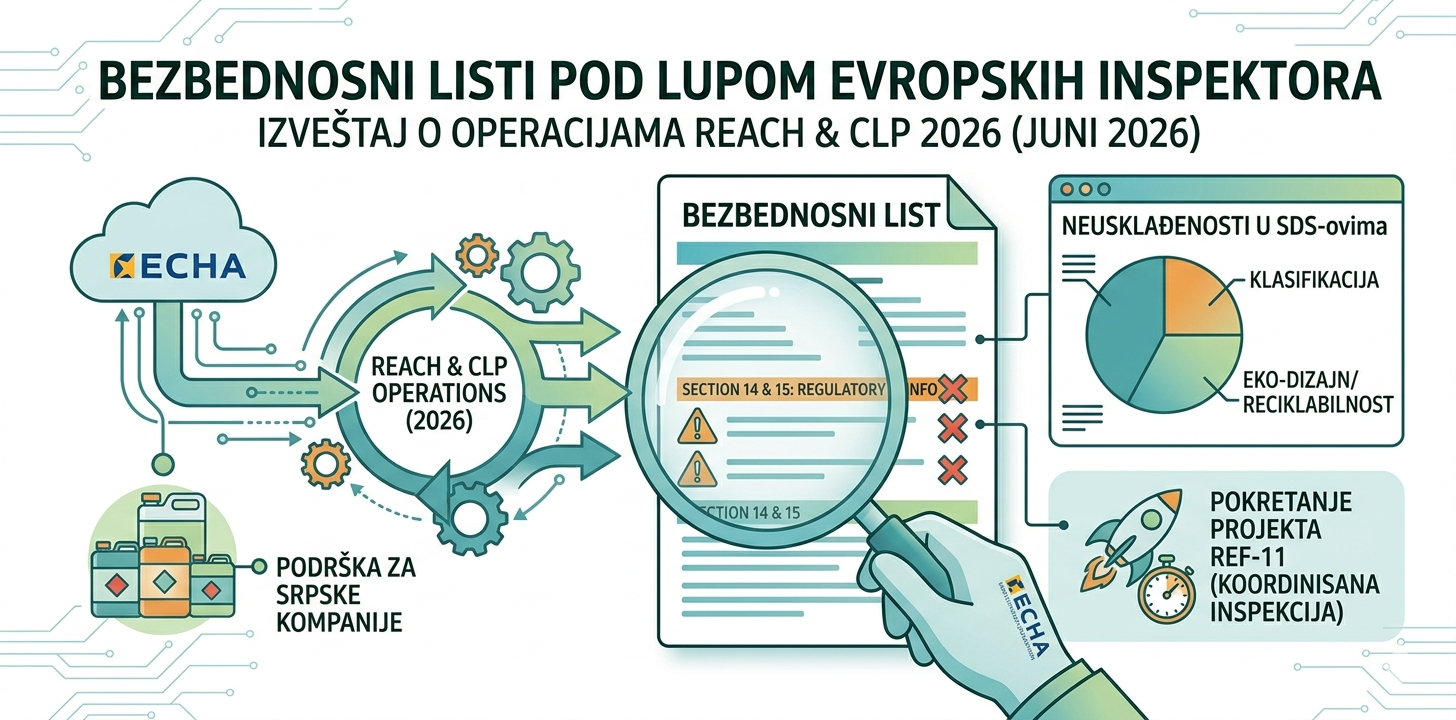
Safety data sheet inspections in the EU uncovered such a level of non-compliance that the ECHA Enforcement Forum launched a dedicated coordinated project. This is not a hypothetical threat: the REF-11 project was devoted exclusively to SDSs and was carried out in 2022 in 26 countries, with around 2,500 inspections. Its findings were shaped into recommendations that still apply today.
What inspectors looked for, what they found and what a ready SDS looks like is what this post is about.
What EU inspectors check in an SDS
An inspection is not a superficial format check. Inspectors go into the content, section by section, focusing on the ones that statistically contain errors most often.
Section 3 and Section 2 – Composition and hazard identification. All components above the disclosure thresholds must be listed in section 3 with correct CAS numbers and current harmonised classifications. This is the starting point for classifying the mixture in section 2: if the component classifications are outdated or incorrect, the mixture classification in section 2 will be wrong as a direct consequence.
The ECHA report explicitly mentions imported mixtures as a particularly problematic category. For them, the rate of non-compliance with registration obligations was as high as 32%. 1 in 3 safety data sheets had serious problems in this area.
Exposure scenarios in extended SDSs (eSDS). For registered substances, scenarios must be attached and must match the recipient’s actual use. In practice, many suppliers send generic scenarios that do not cover specific uses.
New hazard classes – a new reason for revision
Since November 2024, the revised CLP Regulation (EU 2024/2865) has been in force. It introduces new hazard classes: endocrine disruptors for human health and for the environment, as well as the PBT/vPvB and PMT/vPvM categories. Substances that fall under these classes must be reclassified. SDSs must be updated accordingly.
This is not a change that can wait until next year.
Serbia and the time lag
Serbian legislation follows the EU with an average delay of 12 to 18 months. Companies operating exclusively on the domestic market are not yet obliged to apply the revised CLP with its new hazard classes. But this is a temporary situation.
For companies exporting to the EU, there is no delay. EU customers apply EU regulations. SDSs coming from Serbian suppliers must comply with those regulations already today. An inspector visiting the customer may ask about the origin of the document.
A quick internal check before an inspection
Before engaging an external consultant, you can check a few key points yourself.
Look at the date of the last revision of the SDS in the header. If it is older than two years, there is a high probability that at least one change to a harmonised classification has not been incorporated in one of your products.
Compare the classification in section 2 with the current entry for that substance in the ECHA CHEM database at chem.echa.europa.eu. The database is publicly available and free.
For mixtures, check that all components above the disclosure thresholds are listed in section 3 with correct CAS numbers and current classifications.
If you supply a substance registered in a tonnage band that requires a chemical safety assessment, check that the eSDS contains scenarios covering your customers’ uses.
Frequently asked questions about safety data sheet inspections
How often do inspectors check safety data sheets in the EU? The ECHA Enforcement Forum coordinates inspections in an annual cycle. Each REF project lasts 3.5 years and includes an operational phase in which inspections are carried out. Safety data sheets are a topic that recurs across several cycles.
What happens if an inspector finds a non-compliant SDS? The competent authority of the country where the inspection was carried out takes measures under national law. Consequences range from an order to bring the document into compliance to a ban on placing the product on the market, depending on the seriousness of the failure and the jurisdiction.
Do Serbian companies need an SDS that complies with EU regulations? If you supply chemicals or mixtures to customers in the EU, your SDS must comply with EU legislation, regardless of where your company is based. The EU customer answers to its national inspectors under EU rules.
How do I check whether the harmonised classification of my substance is up to date? Use the ECHA CHEM database (chem.echa.europa.eu). Enter the CAS number or the substance name and check the current entry in CLP Annex VI.
How much does an SDS revision cost? It depends on the number of SDSs, how outdated they are and the sector. VETREN offers a no-obligation assessment, so contact us before you estimate the scope of work yourself.
If you have not reviewed your documentation for a while, now is a good time. Safety data sheet inspections have become a regular part of the EU enforcement cycle, and coordinated actions across 27 countries plus Norway, Iceland and Liechtenstein leave less and less room for accidental oversights. Contact VETREN for an assessment of your SDS documentation.
References:
- Report on the operation of REACH and CLP 2026, June 2026.
- ECHA CHEM database
- ECHA Forum REF-11: What can we learn from the EU analysis of SDS quality?
- SDS quality 2025: are your safety data sheets ready for inspection?
- Stop juggling: why creating SDSs must not be an ‘extra task’
- REF-14: What the EU inspection checks in 2026 and why it matters to you if you export
- ATP 22 CLP: A reminder ahead of the 1 May 2026 deadline
This blog post is for informational purposes only and does not constitute legal advice. For specific situations, consult a licensed chemical adviser or a lawyer specialising in chemical regulation.
← Back to blog