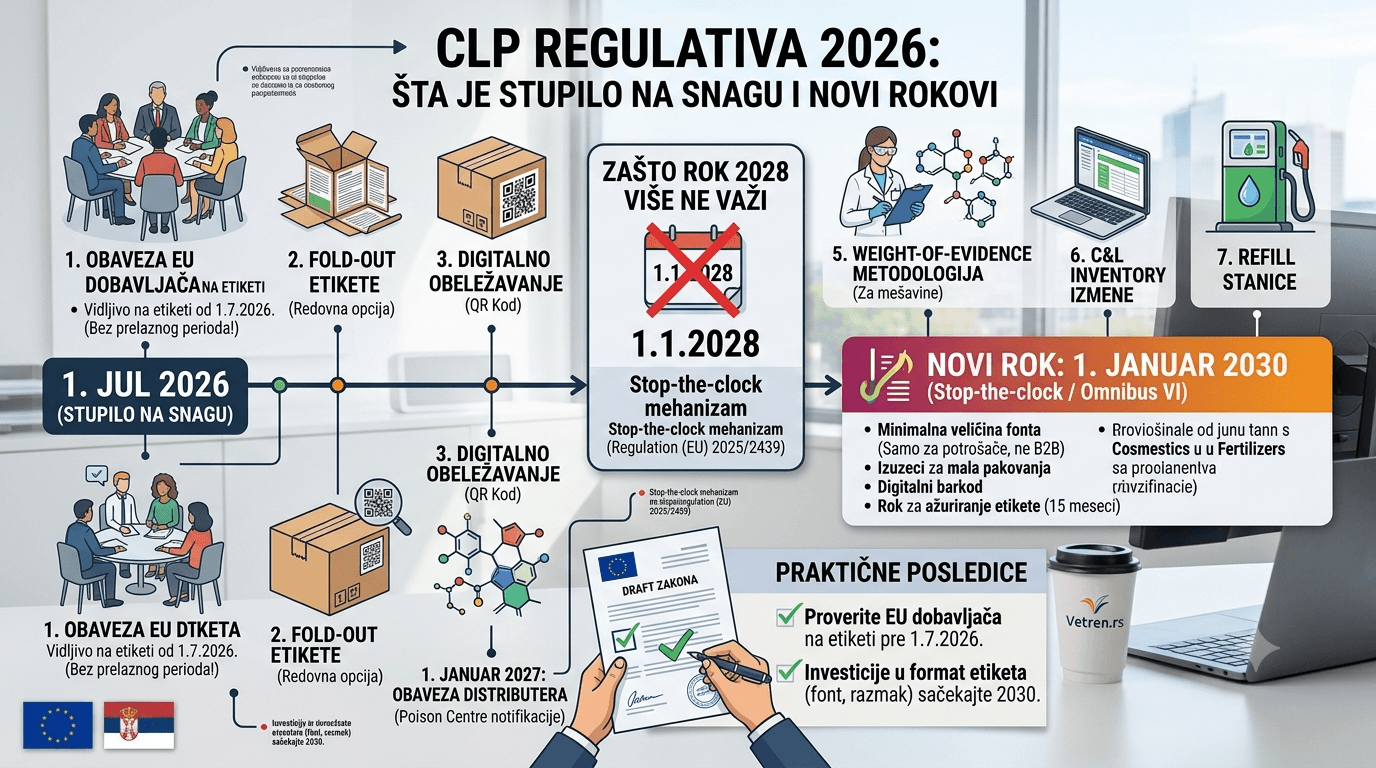
CLP regulation 2026: what has entered into force and why the 2028 deadline no longer applies
05/07/2026 | By Ivan Milenković
The 2026 CLP regulation brings the first of three planned waves of changes. On July 1, part of the revised CLP regulation entered into force. If you export chemicals, detergents or other products to the European Union, this concerns you directly.
Most articles on this topic mention January 1, 2028 as the big deadline for the new labelling rules. That deadline, however, no longer stands. In mid-June 2026 it was moved to January 1, 2030. Below we explain exactly what applies from July 1, what has been postponed, and why the deadline has moved for the second time.
What “revised CLP regulation” means
The CLP regulation (Regulation (EC) No 1272/2008) sets out the classification, labelling and packaging of chemicals in the EU. In October 2024 a major revision of it was adopted, Regulation (EU) 2024/2865. That revision amends dozens of articles, introduces new obligations for suppliers and opens the way for digital labelling.
The revision did not enter into force all at once. The legislator split its application in advance into three waves: July 1, 2026, January 1, 2027 and January 1, 2028. The first wave has just begun.
What entered into force on July 1, 2026
The most important novelty for exporters is the obligation for every product on the EU market to have a supplier established in the Union. That supplier must be shown directly on the label. This is laid down in Article 4(11) of Regulation (EU) 2024/2865.
If a company is not established in the EU, it must designate someone to take on that role. This can be an importer, an authorised representative or a distributor. That person or company guarantees that the CLP requirements are met for the specific product and must be visible on the label.
Along with this obligation, the following changes also apply from July 1:
- Fold-out labels become a regular option for all products, not just an exception for small or unusually shaped packaging.
- Digital labelling gets an official legal framework. Anyone who decides to use a digital label must have a physical data carrier, for example a QR code, attached to the packaging.
- New classification rules for so-called “complex substances”, substances with multiple constituents. In addition, a weight-of-evidence methodology has been formalised for mixtures without direct test data.
- Changes to the ECHA classification and labelling inventory (C&L Inventory). They affect how data is notified and which information becomes publicly available.
- Rules for refill stations for companies that sell chemicals that way.
Everything listed already applies. There is no transition period for the EU supplier obligation, so this is a priority for reviewing your portfolio right away.
What comes on January 1, 2027
The second wave mainly concerns distributors. Anyone who changes a product’s name, repackages it or sells hazardous mixtures into another member state will have to submit the information needed for emergency health response, the so-called poison centre notification. Until now this obligation applied only to manufacturers and importers.
Why the 2028 deadline no longer exists in its original form
Part of the rules in the revision was controversial. The main points of dispute were the label format requirements (font size, spacing, colour) and the rules on advertising, distance selling and labelling at petrol stations. Industry warned that these requirements were too costly and technically hard to implement, especially for small and medium-sized enterprises.
In response, the EU launched the so-called “stop-the-clock” mechanism. The Council of the EU formally adopted that proposal on November 17, 2025, and the text, Regulation (EU) 2025/2439, was published in the Official Journal on December 3, 2025. It moved the application of the disputed provisions to a single date. Instead of July 1, 2026 and January 1, 2027, the new common deadline became January 1, 2028.
This was the first part of a wider package known as Omnibus VI. The second part of that package contains permanent, substantive changes to the same rules. At the time the stop-the-clock mechanism was adopted, that second part was still under negotiation.
New development: deadline moved to 2030
Negotiations on the second part of the Omnibus VI package finished faster than expected. The Council of the EU and the European Parliament reached a provisional political agreement on the night of June 16 to 17, 2026. The agreement simplifies the CLP regulation, as well as the regulations on cosmetics and fertilisers.
One of the key changes is a further postponement of the deadline. Instead of January 1, 2028, the new date of application becomes January 1, 2030. The aim is for all three regulations to start applying on the same day.
On the substantive changes to CLP, the following was agreed:
- A minimum font size on the label remains mandatory, but only for products intended for consumers, not for B2B trade.
- Specific exemptions are introduced for small packaging, including, for example, printer cartridges.
- A digital barcode on small inner packaging is allowed, provided the same information is also available on the outer packaging.
- The deadline for updating the label after a change in classification will be 15 months.
It is important to note that this is a “provisional agreement”, that is, a provisional political deal. The text still has to be formally confirmed by the Council and the Parliament. This is followed by legal-linguistic revision, and only then publication in the Official Journal. Formal adoption is expected during 2026. In theory, details can still change at that stage, although this is rare in practice.
Practical consequences for exporters to the EU
Companies that place products on the EU market should do the following:
- Check who your EU supplier on the label is. If you export directly or sell through a platform outside the EU, you must have an identified supplier established in the Union, visible on the label, as of July 1, 2026.
- Don’t rush investments in label format. The font, spacing and colour requirements have been moved to 2030, not 2028. Funds planned for adapting packaging can wait.
- Follow the further course of Omnibus VI. The June agreement is political, not legally final. Formal adoption and publication in the Official Journal are still to come.
- Keep the dual system in mind. The Serbian CLP Rulebook usually follows EU changes with a delay of one to one and a half years. For products intended for the domestic market, the domestic rulebook still applies. The EU market, on the other hand, requires following current European regulation.
Frequently asked questions
Does the EU supplier obligation also apply to small businesses? Yes. Regulation (EU) 2024/2865 makes no exemption by company size for this obligation. What is being moved in time are other rules, such as label format.
Does this apply to products intended exclusively for the Serbian market? Not directly. CLP obligations from the EU regulation apply to products placed on the EU market. For the Serbian market, the relevant document is the domestic CLP Rulebook, which is aligned with EU rules separately.
Is the 2030 deadline final? For now it is a provisional political agreement. The final date will only be known after formal adoption and publication in the Official Journal of the EU, which is expected during 2026.
Conclusion
The 2026 CLP regulation has started applying the first of three planned waves of changes, with the EU supplier obligation on the label as the most important novelty. At the same time, the deadline that applied until now to the remaining, more controversial changes, January 1, 2028, is already out of date. After the June 2026 agreement, that deadline moves to January 1, 2030.
For exporters to the EU, this is the moment to check who their responsible supplier on the label is. It is also the moment to align plans for further investment with the new, more realistic deadlines.
References:
This blog post is for informational purposes only and does not constitute legal advice. For specific situations, consult a licensed chemical adviser or a lawyer specialising in chemical regulation.
← Back to blog