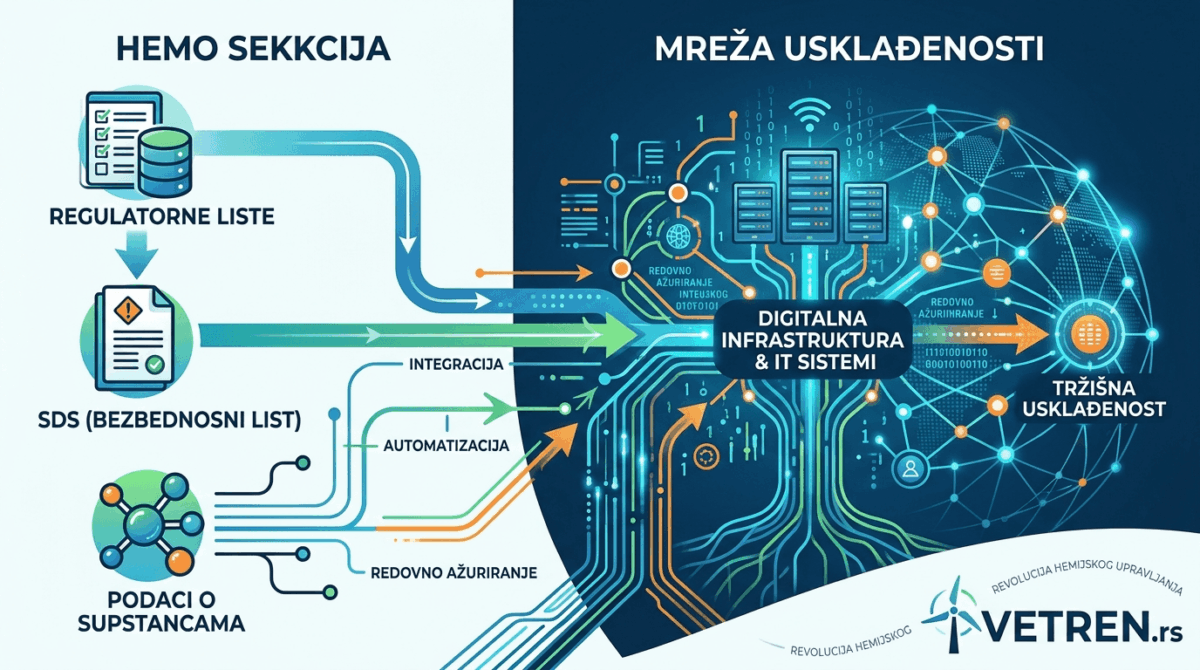
From substance to product, the full compliance network
23/08/2026 | By Ivan Milenković
A compliance check usually boils down to one question: do you have a safety data sheet. If you have one, whether new or existing, a large part of the job really is done. The substance has been identified, the mixture has been classified, the document exists in the prescribed format. Still, that is not the whole job, because the compliance network does not stop at that document.
If your chemicals management system is just a library of SDSs in a folder on someone’s computer or in a binder in the office, you don’t actually have a chemicals management system. You have an archive of a single moment. The question that archive does not answer is what happens when that moment changes, and it changes all the time.
The initial check goes through several lists, not one
When a product is checked for the first time, it is rarely a matter of a single list. There are general lists that apply to almost everything: the SKS list as the domestic equivalent of harmonized classification, and the candidate list for SKIZ as the equivalent of the list of substances of very high concern. Those two follow every chemical, regardless of its intended use.
Then come the lists specific to the product type. A biocidal product is checked against the list of approved active substances for the relevant product type. A detergent falls under a separate regulation on detergents, with its own requirements for composition and labelling. A plant protection product goes through the register of plant protection products, which is separate from the general chemicals framework. Each product type adds its own layer, and that layer is not skipped just because the general check has already been done.
There is also a third layer, which relies not on law but on industry. The automotive industry has GADSL, a joint list of substances that suppliers must declare, and every major vehicle manufacturer as a rule adds its own list as well, partly overlapping with GADSL and partly with additional requirements. Something similar exists in the aerospace and defence industry, through the AD-DSL maintained by IAEG, an international association from that sector. These lists are not regulations in the legal sense, but in practice they are mandatory, because the customer further down the supply chain demands them. Anyone supplying these sectors gets an additional check that comes not from the law but from the contract.
Efficient monitoring here does not mean checking all the lists once. It means knowing in advance which lists apply at all to a given product and to the sector it is supplied to, so that the check is not rediscovered from scratch for every new item that enters the portfolio.
Export doubles the work
When a product stays on the domestic market, the list of relevant lists is already long enough. As soon as exports to the EU market begin, that list practically doubles. It is not one list that is added, but a whole additional network of obligations.
There are the individual annexes of the REACH and CLP regulations, from the authorisation list and the restriction list to harmonized classification. Alongside them come lists specific to particular sectors, as well as the regime for the import and export of hazardous chemicals, known as PIC. Each of those lists has its own rhythm of amendments, independent of the others.
Many companies also follow the SIN list, a voluntary list that often signals future regulatory moves. Based on it, they plan the substitution of hazardous substances with less hazardous alternatives, before the obligation even arrives. The law does not require that work, but it later saves both time and money.
The EU market also brings noticeably stricter oversight of documentation. The safety data sheet and accompanying documentation are checked more often and in more detail, so a mistake that would slip through on the domestic market quickly surfaces here. On top of all that, the announced digital product passport (DPP) for more and more categories brings yet another layer of data that will have to be kept in order.
An illustration of how much this part changes: at the end of August a new delegated regulation was published that extends the PIC list by several dozen substances, applying from October 1, 2026. An exporting company that has not been following that list only learns about the change when its shipment gets stuck at the border or with a partner. That is just one list among many, and it changes independently of domestic deadlines.
The compliance network keeps moving after the first check
This is where the part that is most easily forgotten begins. A check is not a one-off event but a point on a continuous line. The classification of a single substance goes through a recognizable sequence: the identity of the substance, its classification, its concentration in the mixture, the source of that data, the resulting regulatory status, the rules that apply, and only then the safety data sheet, the label and the product itself on the shelf.
Every link in that chain can move. The SKS list is updated periodically; the current version is 88/25 from October of last year. The PIC list changes independently, as was just shown. Harmonized classification at EU level goes through its own cycle of proposals and adoption, which has already been covered on this blog. When any link moves, everything that comes after it needs to be checked again, including a product that has long been on the market.
Who in the organization checks whether a change affects the portfolio
This is a question that rarely has a clear answer. Someone is responsible for following the SKS list, the PIC list and all the lists specific to the type of product the company manufactures and/or sells. Then, when one of them changes, that same person needs to know exactly which products in the portfolio contain that substance at all, in what concentration and with what consequences for the classification of the mixture.
For a small portfolio, with a few products and one market, this can still be managed manually, with discipline and regular checks. For a larger portfolio, with dozens or hundreds of mixtures, across several markets and with different product types, manual monitoring hardly holds up without gaps. The number of lists grows with the number of product types, the number of markets grows with exports, and all of that has to be cross-referenced with every single mixture.
The question that naturally arises is whether this process can be run at all without a tool that links the substance to the product and raises an alert by itself when something changes. That is a question for a separate article, and we will come back to it.
Frequently asked questions
Is it enough to have a safety data sheet for a product to be compliant?
Not entirely. The safety data sheet confirms that the product was checked and classified at the time it was prepared. It does not confirm that this classification stays accurate when one of the applied lists is later amended.
Which regulatory lists are relevant for chemical products in Serbia?
As general lists, the SKS list, NOH, the SKIZ list and the candidate list for SKIZ apply. Depending on the product type, lists specific to biocidal products, detergents or plant protection products are added.
Does the list of relevant lists differ depending on the product type?
Yes. General chemicals go through the general lists, while biocidal products, detergents and plant protection products have their own additional lists tied to their intended use.
Why does export further complicate the check?
Export adds the regime for the import and export of hazardous chemicals, PIC, as a separate layer on top of all the lists that already apply to the domestic market. That layer changes independently of domestic deadlines.
Who should follow amendments to regulatory lists in the company?
In practice, a specific person has to be responsible for following all the relevant lists and for checking whether a change affects existing products. Without clearly assigned responsibility, that check often does not happen at all.
How often do these lists change?
At different rates. The SKS list was updated twice in 2025, the PIC list changes independently according to an international calendar, and harmonized classification at EU level goes through its own cycle throughout the year.
This blog post is for informational purposes only and does not constitute legal advice. For specific situations, consult a licensed chemical adviser or a lawyer specialising in chemical regulation.
← Back to blog