Selling chemicals online in Serbia: obligations and reality
02/08/2026 | By Ivan Milenković
Selling chemicals online is increasingly common in Serbia, yet very few domestic websites show the label, the hazard statements or the safety data sheet next to the product. The regulations require it, but practice often doesn’t follow. A European e-commerce enforcement check found that more than half of the products inspected were non-compliant, even with customs checks in place. In Serbia, on the other hand, the same gap is visible directly on domestic sales pages, with no customs along the way.
That is why this article compares obligations and reality across advertising, the label, the safety data sheet and detergents.
Distance advertising
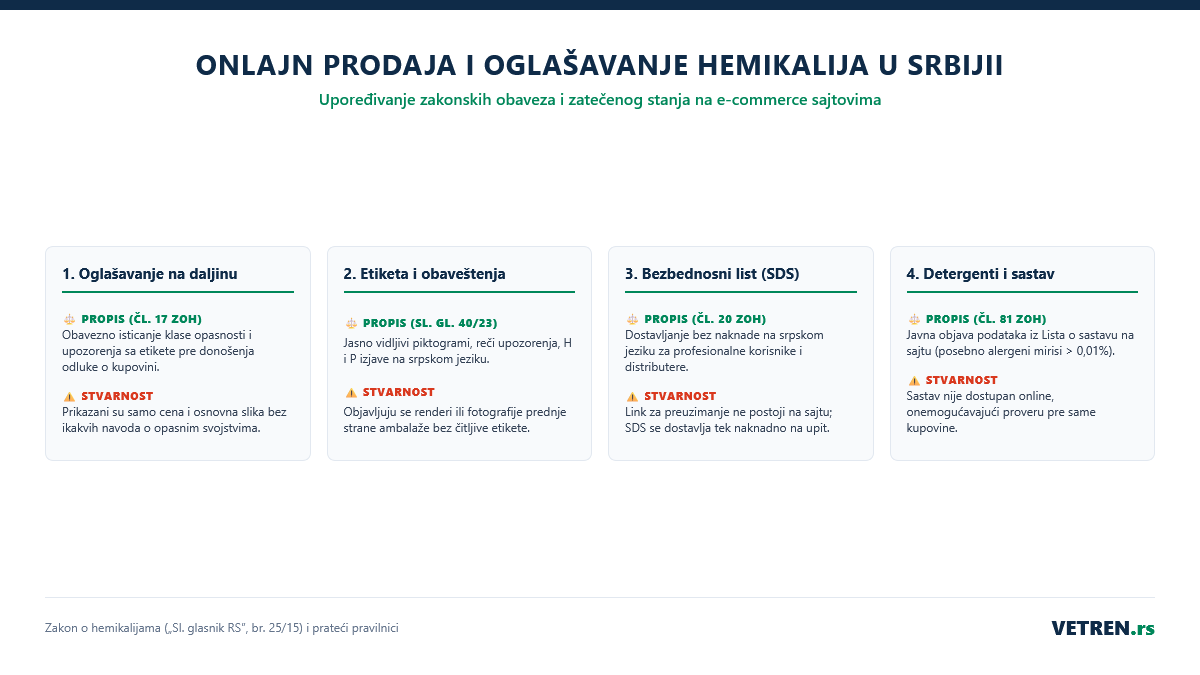
Advertising a hazardous chemical is not unrestricted. Under Article 17 of the Law on Chemicals (“Official Gazette of RS”, No. 25/15), an advertisement must state the hazardous properties. In addition, the advertisement must not mislead the user about those properties.
The Rulebook on classification, packaging, labelling and advertising (“Official Gazette of RS”, No. 40/23 and 91/25) goes a step further. An advertisement for a hazardous substance must also indicate the relevant hazard class or category.
Distance purchasing is a special case. When the buyer cannot see the label information directly, the advertisement must indicate the hazards shown on the label. It must also comply with consumer protection rules. Selling chemicals online is exactly that situation.
In fact, a domestic listing rarely states the hazard class or shows a pictogram. The buyer sees the price and a photo, but not the warning the regulations guarantee them.
The label and hazard statements
A hazardous substance or mixture must carry the prescribed label. It contains the supplier’s name and address, the product identifier, the hazard pictogram, the signal word and the hazard statements. The information must also be given in Serbian. In addition, packaging for general use must not attract children’s attention or resemble food or cosmetics packaging.
The label is the first line of consumer information. Without it, the buyer knows neither which gloves to wear nor how to dispose of what is left over.
However, on domestic websites the product photo often shows only the front of the package, with no legible label. As a result, hazard statements are as a rule missing from the product description. The buyer thus makes a decision without information that would be right in front of them in a shop.
A safety data sheet that cannot be downloaded
A hazardous chemical also comes with a safety data sheet. The supplier is obliged to provide it free of charge and in Serbian, in printed or electronic form. This is set out in Article 20 of the Law on Chemicals. Its content is governed by the Rulebook on the content of the safety data sheet (“Official Gazette of RS”, No. 11/24).
There is a limited exemption for chemicals intended for general use, provided enough safety information has been supplied. Even so, a downstream user or distributor can always request the safety data sheet.
However, the safety data sheet is usually not visible on the website. There is no download link, and at best the buyer receives it only after the purchase. This is a real problem for professional users, who must keep the document on file.
Detergents: the ingredient data sheet and the website
Detergents carry an additional transparency obligation. Under Article 81 of the Law on Chemicals, the manufacturer of a detergent for general use draws up an ingredient data sheet for the detergent. It must also make certain information from that sheet publicly available on a website. More detailed requirements are set out in the Rulebook on detergents (“Official Gazette of RS”, No. 25/15).
Ingredients are listed by type and concentration range. Fragrance allergens are therefore listed by their chemical name if they exceed 0.01%, such as limonene or linalool.
However, the manufacturer’s or seller’s website often lacks this information. A buyer who is allergic to a particular fragrance has nowhere to check the ingredients before buying, even though they are entitled to.
Enforcement and penalties
These obligations come with sanctions. For a commercial offence by a legal entity, the Law on Chemicals prescribes a fine of 1,500,000 to 3,000,000 dinars (Article 97). This covers, among other things, advertising a hazardous chemical without stating its hazardous properties and failing to provide a safety data sheet.
Selling through a website therefore does not exclude liability. The obligations regarding advertising and documentation apply equally to online sales and to sales in a shop.
Selling chemicals online and fair competition
The common denominator is clear. Labelling, the safety data sheet, the ingredient list and advertising rules apply regardless of the sales channel. Distance purchasing does not remove any of these obligations.
This is not only a question of consumer safety. It is also a question of fair competition. A domestic business that pays for classification, label translation and safety data sheet preparation competes with a seller who skips all of that.
That is why compliance is not paperwork. It is the line between an informed and an uninformed buyer, and between fair and unfair competition in the market.
Frequently asked questions
Does an online advertisement for a hazardous chemical have to state the hazards? Yes. Under Article 17 of the Law on Chemicals, the hazardous properties must be stated in the advertisement. For distance purchasing, an advertisement for a hazardous mixture must indicate the hazards shown on the label.
Must the safety data sheet be available to the buyer? For a hazardous chemical, the supplier is obliged to provide the safety data sheet free of charge and in Serbian. A downstream user or distributor can request it at any time.
Does a detergent have to have its ingredients on a website? Yes. The manufacturer of a detergent for general use makes certain information from the ingredient data sheet publicly available on its website.
What does distance purchasing mean when advertising hazardous mixtures? It is a situation in which the buyer cannot see the label information directly before the purchase. That is why the advertisement must indicate the hazards from the label.
Who is responsible for compliance in online sales? Responsibility lies with the person placing the chemical on the Serbian market. Selling through a website does not transfer that responsibility to the buyer.
References:
This blog post is for informational purposes only and does not constitute legal advice. For specific situations, consult a licensed chemical adviser or a lawyer specialising in chemical regulation.
← Back to blog