CO2 tax in Serbia: new rulebooks complete the calculation system
19/07/2026 | By Ivan Milenković
The CO2 tax in Serbia has received its missing numbers and forms. Official Gazette No. 62 of July 8, 2026 published two rulebooks of the Ministry of Environmental Protection. They set the reference and default emission values used to calculate the tax. A week later, issue No. 65 of July 15 brought three rulebooks of the Ministry of Finance. They introduce the tax return forms for both taxes and the rules on data exchange between the Customs Administration and the Tax Administration. All of the rulebooks enter into force on the eighth day after publication. With this, the emissions taxation system established by the 2025 laws has become operational in the full sense. Taxpayers now know both how the tax is calculated and how it is reported.
Two laws, one system
At the end of 2025, Serbia adopted two related regulations, both published in Official Gazette No. 109 of December 4, 2025. The first is the Law on the Tax on Greenhouse Gas Emissions. The second is the Law on the Tax on Imports of Carbon-Intensive Products. Both have applied since January 1, 2026.
The emissions tax covers three gases: carbon dioxide (CO2), nitrous oxide (N2O) and perfluorocarbons (PFC). The taxpayer is a legal entity or sole proprietor that is required under climate change regulations to hold a GHG emission permit. The law lists five activities: production of fertilisers and nitrogen compounds, cement, pig iron, steel and ferroalloys, aluminium and electricity.
The logic of the system is simple. Domestic producers pay tax on the emissions from their installations. Importers pay tax on the emissions embedded in the products they import. This puts domestic production and imports on an equal footing. In both cases the tax is 4 euros per tonne of CO2eq, in the dinar equivalent.
This model is a direct response to the EU CBAM (Carbon Border Adjustment Mechanism). Since January 1, 2026, the EU has been charging a carbon obligation on imports from third countries, including Serbia. The list of products in the Serbian law is based precisely on the CBAM list. For Serbian exporters this is the familiar story of dual compliance: domestic regulations move at their own pace, but EU requirements apply immediately.
Reference values for domestic emitters
The first rulebook concerns the tax on greenhouse gas emissions. It sets reference values for individual production processes. A reference value represents the emissions that are unavoidable despite the use of the most advanced available technology. In other words, the tax does not apply to total emissions, only to what exceeds the technological minimum.
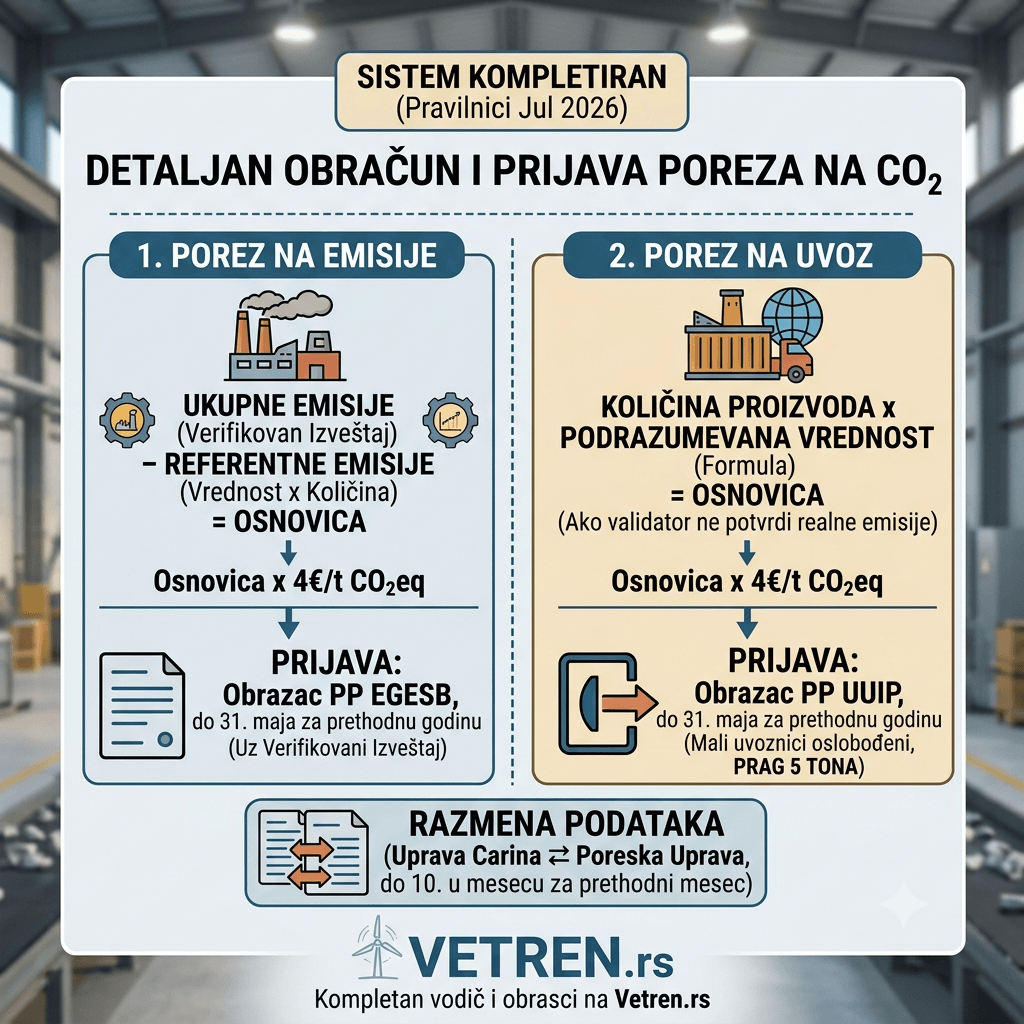
The mechanism in the law is as follows. The tax base is the total emissions from all of the taxpayer’s installations, reduced by the reference emissions. Total emissions are determined from the verified reports that the taxpayer submits under climate change regulations. Reference emissions are the product of the reference value and the quantity of product manufactured in the tax period.
The rulebook sets reference values for the fertiliser, cement, iron and steel and aluminium sectors. A few examples from the annex:
| Production process | Reference value |
|---|---|
| Production of grey cement clinker | 0.6930 t CO2e/t |
| Production of white cement clinker | 0.9570 t CO2e/t |
| Production of liquid pig iron in a blast furnace | 1.2880 t CO2e/t |
| Production of carbon steel in an electric arc furnace | 0.2150 t CO2e/t |
| Production of primary aluminium | 1.4640 t CO2e/t |
| Heat generation in fertiliser production | 47.300 t CO2e/TJ |
For processes not on the list, the reference value for fuel combustion applies. It is 46.20 t CO2eq/TJ. The rulebook also addresses complex installations. If an installation carries out several processes, the reference values apply to each process separately. If the product of one process is an intermediate for another process in the same installation, the reference value applies only to the final product. This avoids double counting of reference emissions.
Default values for importers
The second rulebook accompanies the Law on the Tax on Imports of Carbon-Intensive Products. It contains two annexes. Annex 1 sets reference values by tariff code. Annex 2 sets gross default values for the same products.
The default value for a specific product is obtained with a simple formula. The reference value for the same product is subtracted from the gross default value. If the result is negative, the default value is zero. All values are expressed in tonnes of CO2eq per tonne of product.
The source of these numbers is interesting. In the “Source / method” column, the values in the annexes are listed as CBAM benchmark values. The Serbian system, therefore, does not invent its own methodology. It takes over recognised international values, which the law explicitly requires. The annexes also provide for a phased approach: for some products, specific values apply for production years 2026-2027, and others for the period 2028-2030.
For the chemical industry, the tariff codes from the fertiliser group are particularly relevant. The law covers nitric acid (2808 00 00), ammonia (2814), potassium nitrate (2834 21 00) and mineral fertilisers from headings 3102 and 3105, with prescribed exemptions. For example, the reference value for anhydrous ammonia in Annex 1 is 1.522 t CO2eq per tonne.
What the calculation looks like in practice
An importer has two options for determining the tax base. The first option is the actual emissions, confirmed in a validator’s report, reduced by the reference quantity of emissions. A validator is a person accredited for emissions verification by a body that is a member of the International Accreditation Forum (IAF). The second option applies when a validator cannot confirm the actual emissions. In that case the tax base is estimated: the quantity of imported product is multiplied by the default value from the rulebook.
Let us illustrate the mechanism with a simplified example. Suppose that for a product the gross default value is 2.0 and the reference value is 1.5 t CO2eq per tonne. The default value is then 0.5 t CO2eq per tonne. An importer who imports 1,000 tonnes of that product has a tax base of 500 tonnes of CO2eq. The tax is 2,000 euros in the dinar equivalent. The figures in the example are illustrative. The exact values for each tariff code should be checked in the annexes to the rulebook.
Producers with lower actual emissions have a clear incentive to engage a validator. If the validator’s report confirms emissions lower than the estimate, the tax base is reduced. The same logic drives the EU CBAM and rewards cleaner production.
Threshold, deadlines and tax credit for importers
The taxpayer for the import tax is the person who imports a carbon-intensive product in their own name and for their own account. There is an important exemption. A person who imports less than five tonnes of covered products in a tax period is not considered a taxpayer. Small importers are thus spared the administration.
The tax period is the calendar year. The tax return is filed exclusively electronically, no later than May 31 of the current year for the previous year. The first return, for 2026, must therefore be filed no later than May 31, 2027. The data in the return must match the data in the customs declarations.
The law also provides for a tax credit. If a carbon price for the emissions has already been paid in the country of origin for the imported product, the calculated tax is reduced by that amount. The condition is appropriate documentation: proof of payment, product identification, quantity of emissions and the calculation methodology. The credit cannot exceed the tax liability and is limited in time to the import period or the period immediately following it.
Filing on the PP EGESB form
The rulebooks in Official Gazette No. 65 of July 15, 2026 round off the administrative side of both taxes. For the emissions tax, the Ministry of Finance prescribes the PP EGESB tax return form and accompanying forms.
The return is filed exclusively electronically, by May 31 of the current year for the previous year. It comes with two key attachments. The PIE form is completed separately for each installation. It contains the GHG permit number, the technological process code, emissions by gas, the reference value and the production quantity. The OUE form is the aggregate calculation for all installations. The tax base is shown as the difference between total and reference emissions and cannot be less than zero. The verified emissions report is attached to the return.
The Law on the Tax on Greenhouse Gas Emissions also provides for a tax credit, but with a narrow scope. Only taxpayers whose predominant activity is electricity generation, with at least 80% of revenue from that activity, are entitled to it. The credit amounts to 20% of the funds invested in prescribed emission reduction measures. It cannot exceed 80% of the tax liability. To use the credit, the PK-1 and PK-2 forms are completed and detailed records are kept for each project. VAT is not counted in the investment if the taxpayer is entitled to deduct input tax.
The law also opens a second track. Taxpayers can obtain budget incentives to finance the climate and energy transition, from renewable sources to decarbonisation of industry. The conditions and award criteria are yet to be prescribed by the Government.
The import tax received its own rulebooks in the same Gazette. The return is filed on the PP UUIP form, together with an overview of imports by supplier and tariff code on the UP form. The tax credit is calculated separately for each tariff code, as the lower of two amounts: the carbon price actually paid in the country of origin and the tax calculated under Serbian law. The unused part of the credit is carried forward to the immediately following tax period. Documentation in a foreign language is submitted translated and certified by an authorised court interpreter. A separate rulebook requires the Customs Administration to send the Tax Administration, electronically, by the tenth of each month for the previous month, the data from customs declarations on imports of these products. We will prepare a detailed guide to the return for importers ahead of the first filing deadline.
Differences from the EU CBAM
The Serbian system follows the European model, but it is not a copy of it. The most visible difference is scope. According to the explanatory memorandum to the draft law, hydrogen and electricity are excluded from the Serbian import tax. The reason is negligible hydrogen production and a still undefined methodology for taxing electricity imports. The EU CBAM covers both categories.
The second difference is the price. The Serbian 4 euros per tonne is well below the price of emission allowances in the EU system. For Serbian exporters this means that the domestic tax covers only part of the obligation awaiting them at the EU border. Still, paying at home is not money thrown away. The CBAM logic recognises the carbon price paid in the country of origin, so establishing a domestic system protects the competitiveness of Serbian industry in the long run.
For companies in the covered sectors, July 2026 is the moment to check their own position. Importers should determine whether they exceed the five-tonne threshold and which default values apply to their tariff codes. Producers should compare their actual emissions with the reference values. From now on, the difference between those two numbers has a very concrete price.
References:
- LAW on the tax on greenhouse gas emissions, “Official Gazette of RS”, No. 109 of December 4, 2025
- RULEBOOK on reference values of greenhouse gas emissions for production processes or activities in connection with the tax on greenhouse gas emissions, “Official Gazette of RS”, No. 62 of July 8, 2026
- RULEBOOK on reference emission values and default emission values of CO2eq, “Official Gazette of RS”, No. 62 of July 8, 2026
- RULEBOOK on the form, content and manner of filing the tax return for the tax on greenhouse gas emissions, the manner of exercising the right to a tax credit and the form, content and manner of keeping records of funds invested in financial measures, carbon dioxide equivalent (CO₂eq), “Official Gazette of RS”, No. 65 of July 15, 2026
- RULEBOOK on the form, content and manner of filing the tax return for imports of carbon-intensive products, the manner of exercising the right to a tax credit, the manner of calculating the amount of the tax credit and the documentation required to verify payment, “Official Gazette of RS”, No. 65 of July 15, 2026
- RULEBOOK on the deadlines and data that the Customs Administration submits to the Tax Administration in accordance with the Law on the Tax on Imports of Carbon-Intensive Products, “Official Gazette of RS”, No. 65 of July 15, 2026
This blog post is for informational purposes only and does not constitute legal advice. For specific situations, consult a licensed chemical adviser or a lawyer specialising in chemical regulation.
← Back to blog