Working draft of the new Chemicals Act: impressions from the round table at the Serbian Chamber of Commerce
28/06/2026 | By Ivan Milenković
On Monday, June 22, 2026, the Serbian Chamber of Commerce (PKS) hosted a round table on the working draft of the new Chemicals Act. The Ministry of Environmental Protection presented the directions the new chemicals law is taking. There were about 50 participants in the room, from industry, professional associations and the ranks of chemical advisers.
An important note: this is a working draft that is not yet finished. The official public consultation on the bill is still to come. The round table at PKS was an opportunity for early dialogue with stakeholders, not a presentation of the final text.
Why an entirely new law
The chemicals field in Serbia is currently governed by 38 acts: 3 laws and 35 implementing regulations. The law at the base of this system was adopted in 2009 and last amended in 2015. The Ministry concluded that amendments are no longer an adequate response. The plan is to draft an entirely new law.
There are several reasons. Serbia has to meet the benchmark requirements under negotiating chapters 1, 3, 27 and 28. The EU regulatory framework that Serbia needs to take over has developed significantly since 2009. The new rules on detergents, the Mercury Regulation (EU 2017/852) and the PIC Regulation (EU 649/2012) require a legal basis that does not currently exist. On top of that, the digitalization of public administration calls for a new legal framework.
The new law will have a considerably broader glossary than the current one, with over 40 defined terms. Some are technical corrections: “stavljanje u promet” (putting into circulation) becomes “stavljanje na tržište” (placing on the market) to align with EU terminology. Others are entirely new: UVCB substances, substances for reuse, distance selling, digital labelling.
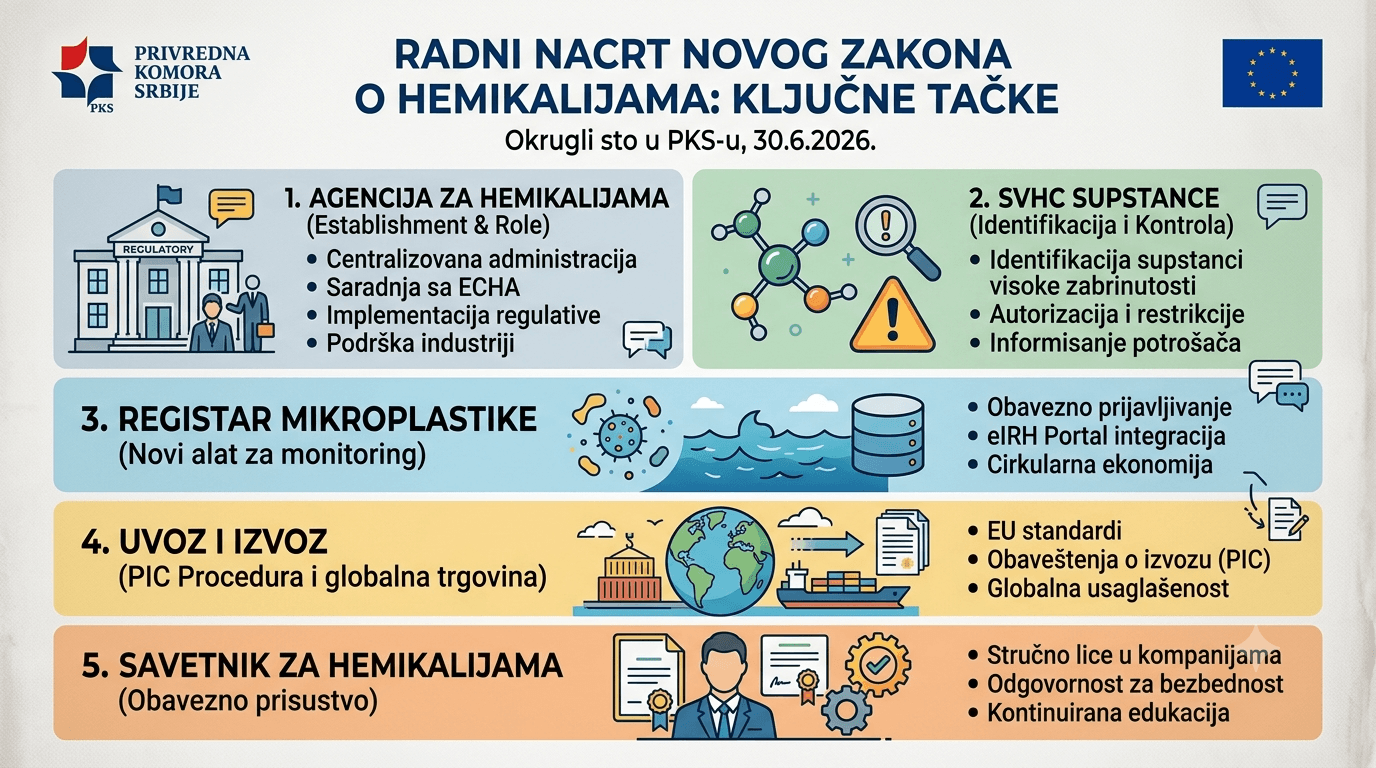
Chemicals Agency
One of the structural proposals is to set up a Chemicals Agency as a separate regulatory body. This is a benchmark requirement from Chapter 27. It means bringing the inspection body under one roof and increasing capacity to enforce the regulations. At present, the Ministry performs both normative and executive functions. That is not sustainable in the long run, especially if authorisation of SVHC substances is introduced.
SVHC substances and national authorisation
This is perhaps the most complex novelty in the working draft. Serbia would set up a national approval system for substances of very high concern (SVHC). It is the functional equivalent of authorisation under REACH Annex XIV.
A technical commission within the competent authority would decide on approvals. A ban on placing on the market would apply in several situations: when a substance is put on the list and the sunset date passes, when a renewal of the approval has not been obtained, or when the competent authority issues a decision terminating the approval.
The idea is clear. Complicated procedures and financial costs are meant to discourage the use of SVHC substances and encourage the switch to alternatives. The EU applies the same approach through REACH, supported by ECHA and a developed industrial infrastructure.
The question that remains open is capacity. Will the new Chemicals Agency be able to run such complex processes? Will Serbian industry have the human and financial resources to take part in them? These are questions for the official public consultation.
Microplastics register
The new law introduces a register of intentionally added microplastics as part of the integrated chemicals register. The reporting obligation covers manufacturers, importers and downstream users of microplastics. The deadline for the annual report is March 31 for the previous year.
Once the law is adopted, the Ministry has to draft the accompanying rulebook and adapt the eIRH portal. What the report will contain remains to be seen, but EU experience with the IUCLID system provides a good basis for an educated guess.
Import and export: recyclate and UVCB substances
The working draft introduces electronic reporting on the import and export of hazardous chemicals. For UVCB substances, there is an obligation to submit a request to the competent authority no later than 30 days before import or export. A practical example mentioned at the round table is ash, which as a UVCB substance is traded in large quantities. The question that remains open is how this obligation will apply to UVCB substances imported or exported in smaller quantities.
A particular novelty concerns recyclate. Currently, recycled substances are treated as waste until they cross the border, while importers in the EU treat them as a substance. The new law provides a mechanism for changing their status from waste to a substance for reuse. The basis is the recycling documentation. This should make trade in these materials easier.
Chemical adviser: the topic that set the room on fire
No topic provoked as many reactions. In the room sat some fifty people whose job or business depends directly on how this area will be regulated.
The working draft provides for several changes. The licensing exam would be taken at the Ministry. Cross-border provision of services would be possible under certain conditions, without the obligation to establish a seat in Serbia. Qualifications obtained in the EU or in countries with which Serbia has an intergovernmental agreement could be recognised with confirmation from the competent authority. A legal basis is also introduced for supervising organisations that run adviser training.
Behind these technical changes lies a context that was stated plainly at the round table. Representatives of the Ministry did not hide their dissatisfaction. Their assessment was harsh: of some 1,600 licensed advisers, they know the competent ones by name. There was mention of an overproduction of advisers and an unacceptably low level of some training programmes. As a symptom, they cited the quality of the questions that reach the Ministry’s help desk.
Reactions in the room were divided. Some of the advisers present objected to the structure of the training, which is geared towards passing the exam rather than preparing people for the job. The round table ended with an open dispute between Ministry representatives and one of the advisers present, precisely on the relationship between the quality of the help desk’s service and the quality of the questions asked.
The problem behind all this is not new. I wrote about it almost a year ago – Stop juggling: why creating SDSs must not be an ‘extra task’, in the context of advisers who juggle dozens of obligations at the same time. Companies that hire advisers pro forma meet the legal obligation on paper. Under such conditions the quality of the work can hardly be high.
What went unsaid: the system that led to this state of affairs did not come about by itself. The absence of inspection oversight, too few inspectors and a regulatory framework that did not prevent the overproduction of licences are all part of the same system. The Ministry that notes the consequences is at the same time part of the cause. The new law is an opportunity to change that. But only if the new Agency gets both the capacity and the mandate to actually enforce the rules.
What next
The working draft presented at PKS is not a finished document. The official public consultation is still to come. That will be the real opportunity for structured comments from industry, professional associations and the expert community.
The topics opened at this round table require serious analysis before they end up in the final text of the law. Whether the public consultation will be long and open enough to allow for that remains to be seen.
References:
- Stop juggling: why creating SDSs must not be an ‘extra task’
- The new Chemicals Act in Serbia: the Ministry of Environmental Protection’s starting points
- Microplastics in Serbia: 5 deadlines you need to know
- Microplastics - Entry 78: Reporting and labelling obligations
- Microplastics - Entry 78: Action plan - what to do right away
This blog post is for informational purposes only and does not constitute legal advice. For specific situations, consult a licensed chemical adviser or a lawyer specialising in chemical regulation.
← Back to blog