REF-14: What EU inspectors are checking in 2026 and why it matters to you if you export
15/03/2026 | By Ivan Milenković
If your company places chemical products on the EU market, you should put 2026 in your calendar. The ECHA Enforcement Forum has launched the REF-14 inspection of mixture labelling – a coordinated EU-wide campaign checking the classification, labelling and packaging of hazardous mixtures. Inspectors are already in the field. The operational phase lasts throughout 2026.
What is REF-14?
The ECHA Enforcement Forum is a network of inspection authorities of EU and EEA countries. Every few years the Forum launches coordinated compliance check campaigns. Each campaign has a number and a focus.
REF-11 was about the quality of safety data sheets. REF-14 is about the classification, labelling and packaging of hazardous mixtures in consumer and professional products.
The Forum decided to launch it in June 2024. In March 2025 the Forum confirmed the detailed scope of the project. Preparation and inspector training run through 2025, and the operational phase begins in 2026.
What inspectors check
According to the published project mandate, the check covers three areas.
1. CLP classification and labelling
Are hazardous mixtures correctly classified?
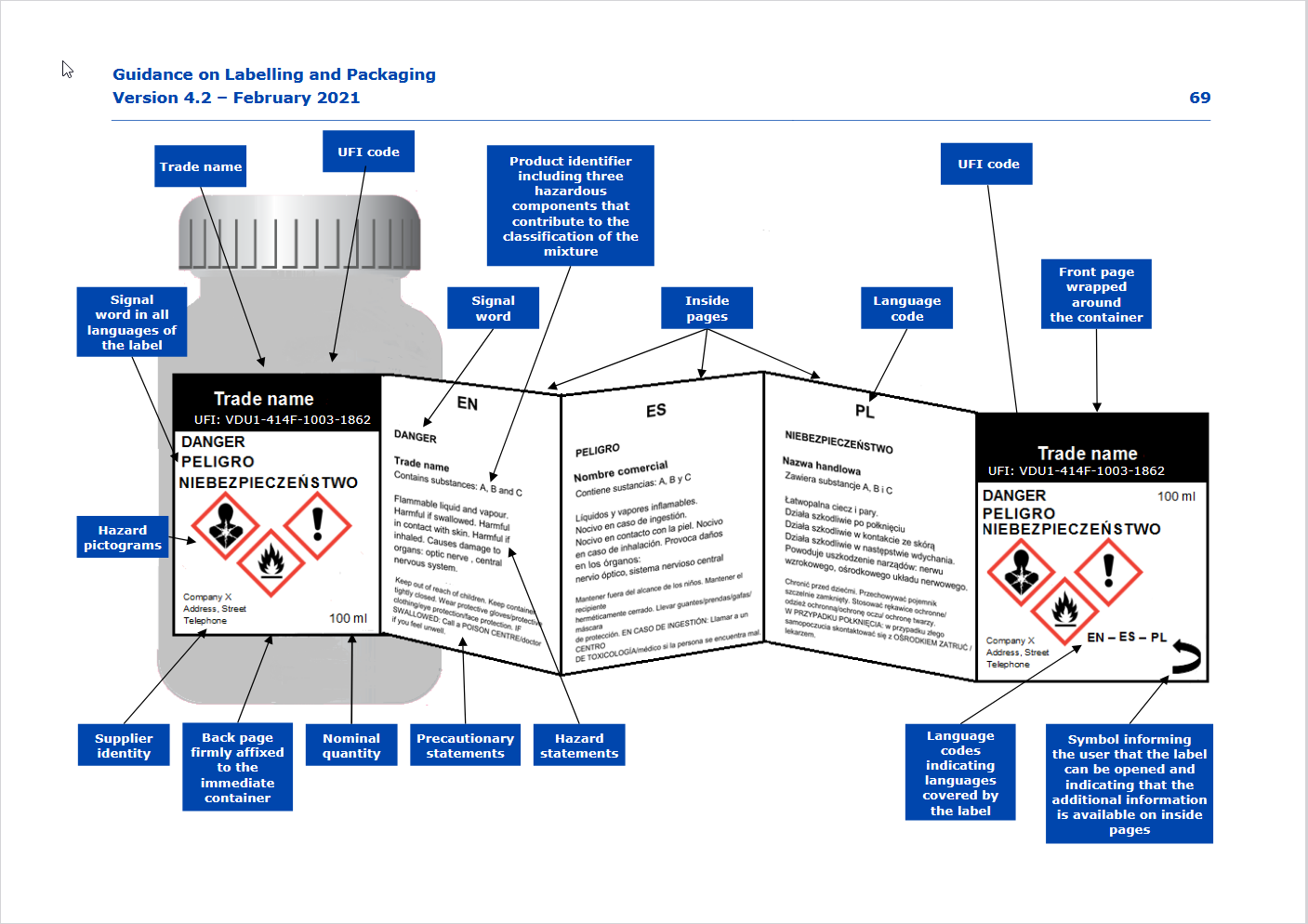
Does the label contain all the required elements: pictograms, H and P statements, supplier identification?
There is a particular focus on products known to contain hazardous mixtures that often lack correct labelling.
ECHA specifically names nicotine products containing acutely toxic substances and air fresheners containing sensitising or irritant substances. The choice is not random – these are categories where previous national campaigns have shown systematic shortcomings.
2. Packaging and child-resistant fastenings
Particular attention is paid to fastenings that make opening difficult for children. If a mixture is classified as acutely toxic or contains substances dangerous to children, and the packaging lacks the required fastening, that is a direct finding.
3. PCN notifications and SDS documents
This is the part many miss. Inspectors will not only check the label. They will also check whether the mixture has been notified to the poison centre (PCN notification under Annex VIII of the CLP Regulation) and whether the safety data sheet complies with current requirements.
Three documents, one visit.
New requirements in scope since March 2025
At the March meeting, the Forum specified the scope of the project. A check was added for new CLP requirements that start applying in 2026 but are still optional:
- Fold-out labels and their compliance with the format rules
- Digital labelling where it has been implemented
- Supply at refill stations
So inspectors will not only look at older compliance. They will also check the new compliance, which is only just entering into force.
Why this concerns Serbian exporters
Serbia is not an EU member. REF-14 inspections are carried out by the inspection authorities of EU countries on their own market. However, your product is on that market.
If you deliver a mixture to a distributor in Austria, Germany or Hungary, that distributor is accountable to the EU inspector. The inspector finds incorrect classification or a missing PCN notification – the finding goes to the distributor. The distributor holds you accountable.
In practice this means termination of the contract, withdrawal of a batch or a demand for urgent correction of the documentation. It all falls on you, even though you are not directly subject to the inspection.
In addition, if you place a product on the EU market directly through your own representative or subsidiary, you are directly within the scope of the checks.
Timeline to remember
| Phase | Deadline |
|---|---|
| Project manual and coordinator training | Q4 2025 |
| Operational phase – inspections | 2026 |
| National coordinators’ reports | Q1 2027 |
| Adoption of the final report | Q4 2027 |
Practical check: three questions for every export product
Before the inspector reaches your customer in the EU, go through the following.
Is the classification up to date? Harmonised classifications change. Revisions of CLP Annex VI are not rare. A classification that was correct two years ago may no longer be.
Is there a PCN notification? If you place a mixture on the market in the EU and it contains hazardous substances under Annex VIII of the CLP Regulation, notification is mandatory. The deadlines passed long ago. If there is no notification, the risk is open.
Is the SDS compliant with current regulation? It is not enough for an SDS to exist. It must be updated in line with current requirements, including current harmonised classifications and relevant SVHC substances.
Frequently asked questions
Does the REF-14 inspection apply directly to Serbian companies? Not directly. EU inspectors check the operators placing products on the market in the EU. However, if a Serbian company supplies EU distributors or has a representative in the EU, there is indirect exposure through the supply chain.
When will the REF-14 report be published? The operational phase of the inspections runs throughout 2026. The Forum adopts the final report in Q4 2027. The results will define future inspection priorities in the area of mixture classification.
What if my distributor in the EU receives corrective measures or a fine? A distributor who receives corrective measures because of non-compliant documentation for your product has grounds to hold you accountable as the supplier. A preventive check is much cheaper than reactive correction under pressure.
Conclusion
The REF-14 inspection of mixture labelling is not abstract EU bureaucracy. It is the announcement of concrete, intensified checks that will last for a year. All three things inspectors check – classification, PCN and SDS – can be put in order before the inspector knocks on your EU customer’s door.
References:
This blog post is for informational purposes only and does not constitute legal advice. For specific situations, consult a licensed chemical adviser or a lawyer specialising in chemical regulation.
← Back to blog