The EU Digital Product Passport registry has launched
26/07/2026 | By Ivan Milenković
The digital product passport registry went live on 20 July 2026. In the same month the European Commission also published a user guide and six harmonised standards, which means the basic infrastructure for the digital passport in the EU has finally taken shape. Below I explain how the registry works and why it should be on the radar of anyone exporting to the EU market.
What the digital product passport registry is
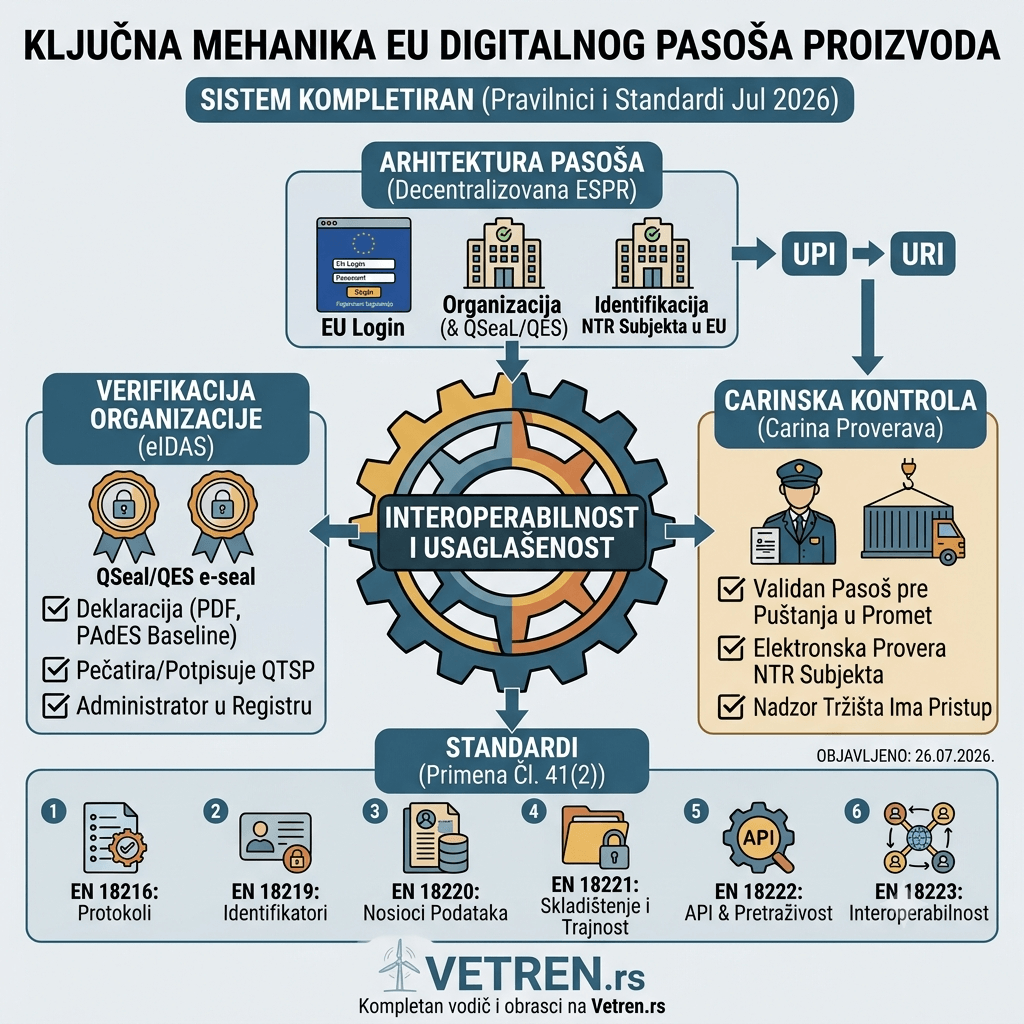
The digital product passport registry is a central EU database that serves as an index of all digital passports for products on the EU market. Let us clear one thing up right away: the registry does not store the whole passport, only unique identifiers, registration data and basic metadata.
The content of the passport itself stays with the economic operator, who keeps it in-house or with a service provider. The architecture is, in other words, decentralised. The legal basis for all of this is Regulation (EU) 2024/1781, better known as ESPR.
Who is obliged to register
Passports can be registered and maintained only by verified economic operators. The term is broad and covers the manufacturer, authorised representative, importer, distributor, dealer and fulfilment service provider, as defined in Article 2(46) of Regulation (EU) 2024/1781.
The obligation arises before the product is placed on the market, and it is introduced gradually, product group by product group. It is also worth adding that the registry expects operators registered in the EU, because the NTR identifier serves precisely to confirm that the operator is registered in the EU.
How enrolment and organisation verification work
Everything starts with an EU Login account. After logging in, the operator enters the organisation’s details, chooses whether it acts as a legal or a natural person, and then moves on to verification.
At that point the Commission locks the entered data into a PDF declaration and applies an electronic seal to it. The declaration is then signed or sealed outside the platform: legal persons use a qualified electronic seal (QSeal), while natural persons acting as sole traders use a qualified electronic signature (QES).
Both the signature and the seal are issued by a qualified trust service provider (QTSP), in line with the eIDAS Regulation, that is, Regulation (EU) No 910/2014. The format must be PAdES Baseline. Once verification is complete, the applicant becomes the administrator of their organisation in the registry.
What actually gets registered
At the heart of registration is the unique product identifier (UPI), an identifier in URL format aligned with the JTC 24 standards. In response, the registry returns a unique registration identifier (URI), which links the registry entry to the passport held by the operator.
This split is key to understanding the whole system. The registry holds only the registration record, while the complete data stays with the operator, who is also responsible for its availability and accuracy throughout the product’s entire life cycle.
Registration is done at three levels: model, batch or individual item. Data can be submitted in two ways: through an electronic form for a single passport, or by uploading an XML or JSON file with up to 100 passports at once.
Batteries as the first product group
The first group for which registration is planned is batteries. There is a catch here: registration for batteries is not yet possible, because the semantic catalogue for this group has not yet been defined.
The digital passport is, in any case, being introduced gradually, and new product groups will follow in line with the ESPR working plan. In other words, the scope of the obligation will widen step by step.
Six harmonised standards for the digital passport
On 14 July 2026 the Commission adopted Decision (EU) 2026/1736, published in the Official Journal of the EU on 15 July 2026. The standards were developed by CEN, Cenelec and ETSI, and their significance is practical: conformity with a standard gives a presumption of conformity with Articles 10 and 11 of Regulation (EU) 2024/1781, as provided for in Article 41(2) of the same regulation.
Six standards have been published:
- EN 18216:2026, data exchange protocols
- EN 18219:2026, unique identifiers
- EN 18220:2026, data carriers
- EN 18221:2026, data storage, archiving and persistence
- EN 18222:2026, interfaces (APIs) for life cycle management and searchability
- EN 18223:2026, system interoperability
Serbian exporters and checks at the border
This is where the story becomes concrete. The registry directly supports customs control, so customs authorities will electronically check that an imported product has a valid registered passport before the goods are released for free circulation. Market surveillance authorities also get access to registered passports.
For Serbian exporters the message is clear: goods without a valid passport may be held up at the border, for those product groups that fall under the obligation. Serbia is not an EU member, but the obligation follows the goods entering the EU market. That is why this mechanism is worth understanding before the obligation reaches your product group, not only once it applies. All of this takes time: processes need to be digitalised, tools, technology and a service provider chosen, a budget secured, and finally implementation begun.
Frequently asked questions
When did the digital product passport registry go live? The registry, the testing environment and the user guide have been available since 20 July 2026.
Does the registry store the whole digital passport? No. The registry stores identifiers and metadata, while the content of the passport stays with the economic operator.
Who can register a digital passport? Only verified economic operators, that is, the manufacturer, importer, distributor and the others listed in Article 2(46) of Regulation (EU) 2024/1781.
Which product group comes first? Batteries. Registration for batteries is not yet functional, because the semantic catalogue has not been defined.
What is needed to verify an organisation? You need an EU Login account and a qualified electronic signature (QES) or seal (QSeal) from a QTSP.
Conclusion
An important implementation step has been taken for the digital product passport. The registry is running, the standards have been published, and customs is getting a tool to check them. For now everything is focused on batteries, with gradual expansion announced, so economic operators exporting to the EU market have some time. Experience says that this time is best used while there is still no pressure.
References:
This blog post is for informational purposes only and does not constitute legal advice. For specific situations, consult a licensed chemical adviser or a lawyer specialising in chemical regulation.
← Back to blog