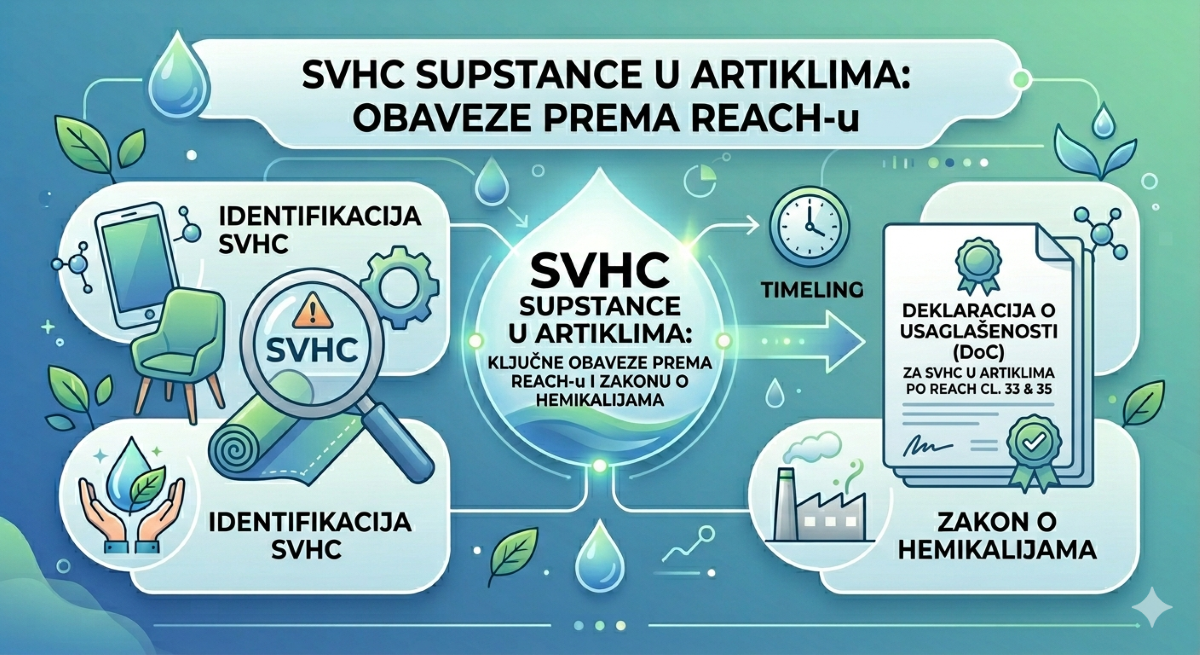
SVHC substances in articles: obligations under REACH and the Serbian Law on Chemicals
14/06/2026 | By Ivan Milenković
SVHC substances in articles are increasingly a focus of attention in supply chains that involve EU companies. Serbian suppliers of a wide range of products, such as valves, pipes, ventilation ducts, seals and similar finished products, are more and more often receiving requests for declarations on the content of hazardous substances. Behind these requests are concrete legal obligations, on the side of both the buyer and the supplier.
An article is not a chemical, but obligations exist
The difference between a chemical and an article is not just a matter of terminology. A chemical is placed on the market because of its chemical composition. An article is an object that does not release substances in significant quantities during use and whose function depends on its shape, surface or design rather than on its chemical composition.
It is precisely this difference that leads many companies to the wrong conclusion: “We sell finished products, not chemicals, so REACH does not concern us.” That conclusion is wrong. REACH Article 33 lays down information obligations specifically for articles containing SVHC substances in a concentration above 0.1% weight by weight.
What SVHC substances are
SVHCs (Substances of Very High Concern) are substances that give rise to particular concern because of their hazardous properties. They include substances with carcinogenic, mutagenic or reprotoxic properties (CMR category 1A and 1B), PBT and vPvB substances, as well as substances with endocrine disrupting properties and other proven serious effects.
ECHA maintains the Candidate List, which is updated twice a year. It currently contains more than 240 substances. Substances from this list may be included in the Authorisation List (Annex XIV), but the obligations under Article 33 apply from the moment a substance enters the Candidate List.
REACH Article 33: who must inform whom
Article 33 of the REACH Regulation lays down two separate obligations.
The first obligation concerns the supply chain. Every supplier of an article containing an SVHC substance in a concentration above 0.1% weight by weight must provide the recipient of the article with sufficient information to allow safe use. The minimum requirement is the name of that substance. This obligation applies without exception regardless of quantities.
The second obligation concerns end users, that is, consumers. At a consumer’s request, the supplier must provide the same information free of charge and within 45 days.
In practical terms, when an EU buyer sends a request for a DoC (Declaration of Conformity) asking for confirmation of the absence of SVHC substances or for information on their content, it is exercising precisely the right granted to it by Article 33.
The Serbian counterpart: Law on Chemicals, Article 27
Serbia has taken over this obligation through the Law on Chemicals. Article 27 provides that the manufacturer, importer or distributor of an article containing a substance that is a candidate for the List of substances of very high concern in a concentration above 0.1% must provide every distributor or downstream user in the supply chain with information sufficient for the safe use of that article, and at a minimum the name of that substance.
The same provision also lays down an obligation towards consumers: on request, the information is provided free of charge. The list of substances referred to in this article is published in the Official Gazette of the Republic of Serbia.
The structure of the obligation is the same as in REACH.
REACH Article 35: workers’ right to information
In addition to the obligations towards buyers in the supply chain, REACH Article 35 introduces a specific right for workers. Workers and their representatives have the right of access to information on substances contained in the articles they work with, if those substances meet the criteria of Article 59(1) of the Regulation, that is, if they are on the Candidate List.
This provision has no direct counterpart in the Serbian Law on Chemicals. In the Serbian legal framework, informing workers about hazardous substances is governed by occupational safety and health regulations.
Information exchange across the whole chain: Articles 28 and 29 of the Law on Chemicals
In Articles 28 and 29, the Serbian Law on Chemicals sets a broader framework for managing information on chemicals. Article 28 requires persons who use hazardous chemicals to handle them safely, in accordance with the information in the safety data sheet and other available information. Article 29 lays down the obligation to exchange new knowledge about the hazardous properties of a chemical among all participants in the supply chain: manufacturers, importers, distributors and downstream users.
These provisions mean that information does not flow only down the chain towards the buyer, but also up towards the supplier, when new knowledge about risks emerges.
Obligations of Serbian companies exporting to the EU
If you supply articles to EU buyers, the obligations under REACH Article 33 apply to your buyers in the EU. They are required to pass the information further down the chain. That is why they ask you for documentation that allows them to do so.
The absence of information is not neutral. If an EU buyer cannot confirm the absence or content of SVHC substances, it takes on the risk of non-compliance itself. Such a supplier becomes a risky partner.
In practice, a supplier that regularly and proactively provides SVHC declarations with its deliveries of articles reduces the buyer’s administrative burden and builds an advantage in the supply chain.
How to check for SVHC substances in articles
The starting point is always the Candidate List on the ECHA website. The list is updated twice a year and is freely available. For each substance on the list, the name, CAS number, EC number and reason for inclusion are given.
The check requires insight into the composition of the materials from which the article is made. Suppliers of raw materials and semi-finished products are required to provide the same information under Article 33, which means that the information obligation is passed along the whole supply chain.
For more complex products, checking the composition may require testing or appropriate technical declarations from component suppliers.
Information on SVHC substances throughout the life cycle of an article
Information generated on the basis of Article 33 does not stop being relevant once the article is transferred to the buyer. It follows the article throughout its entire life cycle, and at the end of that cycle it directly determines how the article can be handled: whether recycling is possible, under what conditions, and which waste treatment comes into consideration.
REACH Article 33 is the starting point of that information, without which managing an article at the end of its life cannot be carried out properly.
Frequently asked questions
Does the obligation under REACH Article 33 apply to all articles regardless of quantity? The obligation towards the recipient in the supply chain applies regardless of the quantity of the article supplied. The only threshold that applies is the concentration of the substance in the article, which must be above 0.1% weight by weight.
Does the 0.1% threshold apply to the whole article or to each component separately? The 0.1% threshold is calculated in relation to the whole article supplied as a single unit. If an article contains several components but is supplied as one whole, the threshold is calculated for that article as a whole. Complex articles supplied separately are treated separately.
What happens when an SVHC substance is added to the Candidate List? The information obligation arises immediately when the substance is included in the Candidate List, with no transition period. Suppliers of articles containing that substance must be able to respond to buyers’ requests from the day of publication.
Who publishes the list of substances of very high concern in Serbia? Under Article 27 of the Law on Chemicals, the list is published by the ministry responsible for environmental protection in the Official Gazette of the Republic of Serbia.
Do the REACH obligations under Article 33 apply to Serbian exporters directly? REACH applies to companies that place articles on the EU market. A Serbian exporter that supplies articles directly to an EU buyer must in practice be compliant, because the EU buyer has an obligation further down the chain and cannot fulfil it without information from the supplier.
References:
This blog post is for informational purposes only and does not constitute legal advice. For specific situations, consult a licensed chemical adviser or a lawyer specialising in chemical regulation.
← Back to blog