
Common Data Platform on Chemicals: the EU is building a single database on chemicals
22/02/2026 | By Ivan Milenković
This is the second article in a series analysing the ECHA Single Programming Document 2026-2028. The first article gave an overview of all the key legislative areas ECHA covers until 2028. Here we focus on one of the biggest structural changes in EU chemicals legislation in recent decades.
Check the substance under REACH. Then the classification under CLP. Then monitoring data on its presence in the environment. Finally, occupational exposure limits. Today that means four different databases, four interfaces, four data formats.
The Common Data Platform on Chemicals (CDPC) aims to change exactly that. The regulation establishing this platform has been adopted, and in 2026 ECHA is actively preparing for its implementation. It is one of the most structurally significant changes in the way the EU manages data on chemicals.
What is the Common Data Platform on Chemicals?
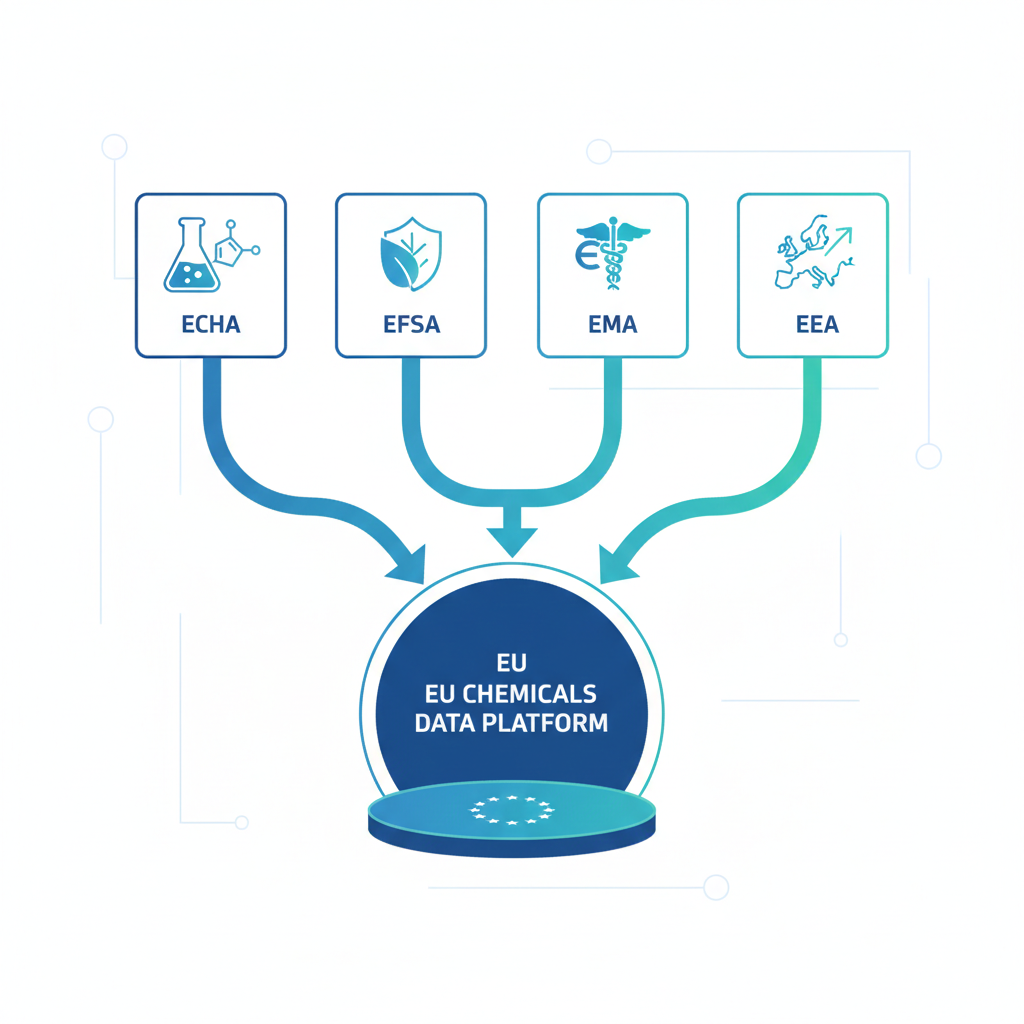
The CDPC is a centralized EU platform that will be managed by ECHA. It will integrate data from several EU agencies:
- EFSA: European Food Safety Authority
- EEA: European Environment Agency
- EMA: European Medicines Agency
- EU-OSHA: European Agency for Safety and Health at Work
Behind this lies the concept of One Substance, One Assessment (OSOA). The principle is simple: the same chemical substance should not be assessed multiple times and in a fragmented way across different regulations and agencies. Instead, the goal is one coordinated, comprehensive assessment.
The CDPC is therefore not just a technical project. It is a change in the way the EU thinks about chemical data.
What will the platform contain?
Under the Regulation, the CDPC will provide access to the following:
- data on chemicals, including the Information Platform for Chemical Monitoring (IPCHEM)
- a repository of reference values: exposure limits, DNEL, PNEC and the like
- a database of study notifications
- information on regulatory processes concerning chemicals
- data on chemicals in articles and products
- information on alternatives to substances of concern
- an overview of obligations under EU chemicals legislation
- a repository of standard formats and controlled vocabularies
- data relating to environmental sustainability
In addition, ECHA gains two new competences. The first is a mechanism for commissioning scientific studies, the so-called data generation mechanism. The second is an active role in the framework for monitoring and analysing chemicals at EU level.
Where does implementation stand now?
In 2026, ECHA is developing architectural, data and business plans. Specifically, the focus is on establishing an internal implementation plan, a governance structure and identifying the minimum data set that makes it possible to build the first functional version of the platform.
The deadlines are set by law and are clear:
- The first version of the CDPC must be operational three years after the Regulation enters into force.
- The database of study notifications has a separate deadline: 22 months after entry into force.
The Commission and ECHA run a joint steering board with the partner agencies. Between four and eight such meetings are planned during 2026.
As for existing services, two well-known ECHA platforms will be gradually shut down. EUON (EU Observatory for Nanomaterials) is expected to be replaced during 2027. EUCLEF (EU Chemicals Legislation Finder) faces the same scenario, and the data of both platforms will be taken over into the CDPC.
Direct impact on Serbian companies: let’s be honest
For companies exporting to the EU, the CDPC changes the context in which data are checked. EU buyers, competent authorities and inspectors will use this platform for quick checks. If the data on your substances and formulations in EU registers are incomplete or out of date, this becomes more visible than ever.
For companies selling exclusively on the domestic market, there are no direct obligations, neither today nor in the foreseeable future. In an EU accession scenario, integration into the CDPC would be part of a broader alignment process, but that is a separate topic with a separate time horizon.
Digital readiness as a prerequisite
The CDPC relies on structured, machine-readable data. Companies that still manage chemical data through Word documents and Excel spreadsheets will not be able to communicate effectively with EU platforms, either directly or indirectly. As a result, digitalizing internal chemical data stops being only a matter of efficiency. It becomes a matter of interoperability with the EU ecosystem.
What to watch in the coming period
The CDPC is still at an early stage. Implementation plans are only being developed, and the architectural design of the platform is just beginning. That is why there are no concrete obligations for companies yet.
Still, being informed at this stage means something. It means understanding what is being built and why. It means following the deadlines set by law. And for companies oriented towards the EU market, it means using this time to put internal data in order before the new platform becomes operational.
At that point there will be no time for improvisation.
Next article in this series: Drinking Water Directive, Article 11, the new approval system for materials that come into contact with drinking water. This regulation opens up an entirely new compliance space for Serbian manufacturers of pipes, valves, coatings and seals. ECHA starts receiving notifications at the end of 2026, and applications start from 2027.
Source: ECHA Single Programming Document 2026-2028. Available at: echa.europa.eu
References:
- First article in the series: “ECHA Programming Document” 2026-2028: What the new EU priorities mean for the Serbian chemical industry
- Single Programming Document 2026 – 2028
- Third article in the series: Drinking Water Directive, Article 11 (IN PREPARATION)
This blog post is for informational purposes only and does not constitute legal advice. For specific situations, consult a licensed chemical adviser or a lawyer specialising in chemical regulation.
← Back to blog