Chemicals and recyclability: why information on SVHC substances must arrive before the waste does
17/05/2026 | By Ivan Milenković
A recycling operator receiving material does not automatically know what it contains. If earlier participants in the supply chain did not pass on information about hazardous substances, the recycling centre makes decisions without key data. Serbia’s Circular Economy Development Programme for 2026-2030 (Official Gazette of RS, No. 41/2026) names exactly this problem as one of the structural obstacles to closing material loops.
Which substances are the problem
SVHC substances (Substances of Very High Concern) cover the categories set out in the REACH Regulation (Regulation (EC) No 1907/2006): carcinogenic, mutagenic and reprotoxic substances (CMR categories 1A and 1B), substances that are persistent, bioaccumulative and toxic (PBT), very persistent and very bioaccumulative (vPvB), and substances giving rise to an equivalent level of concern, including endocrine disruptors.
ECHA maintains the Candidate List of SVHC substances. It currently holds more than 240 entries. Every substance on the Candidate List is subject to the communication obligation under Article 33 of the REACH Regulation when its concentration in an article is above 0.1% weight by weight.
The communication obligation under REACH Article 33
A supplier of an article containing an SVHC substance in a concentration above 0.1% weight by weight must provide the recipient of the article, free of charge, with information that allows safe use. The minimum that must be passed on is the name of the substance. The end consumer has the right to request the same information, and the supplier must provide it within 45 days.
This obligation is not new. Its problem is systemic: it covers the active transfer of information at the moment of delivery, but it does not establish a permanent, structured record that follows the article through its entire life cycle, including the stage when it becomes waste. Information that was not passed on at the moment of purchase practically disappears from the chain.
The SCIP database: the EU’s answer to this gap
The Waste Framework Directive 2008/98/EC, as amended by Directive (EU) 2018/851, introduced the obligation to submit data on SVHC substances in articles to ECHA, through the SCIP database (Substances of Concern In articles as such or in complex objects (Products)). The obligation took effect on January 5, 2021.
Every supplier placing articles containing SVHC substances on the EU market must submit to ECHA information on: the identity of the substance, its location in the article and relevant information for safe handling. This data remains available to recycling operators and waste management authorities, even when the article changes several owners and passes through several countries.
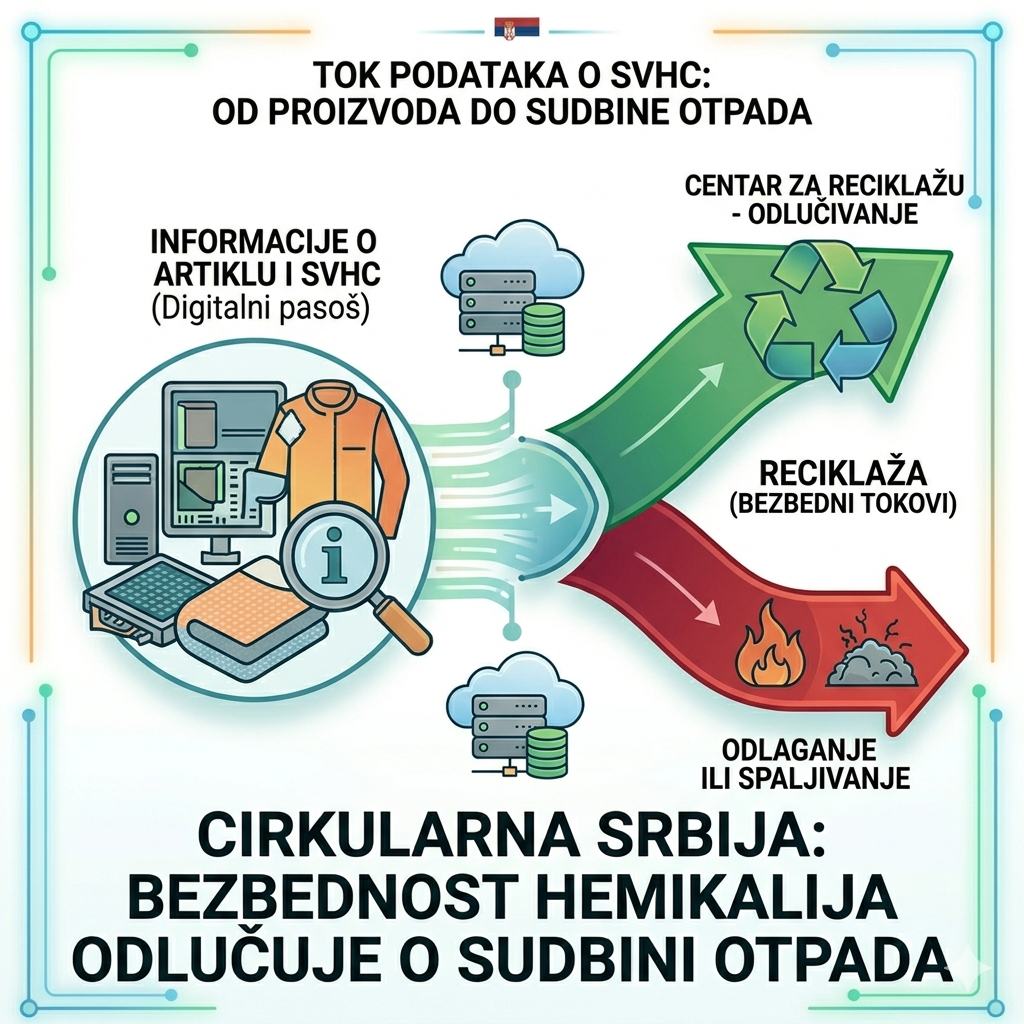
The mechanism is direct: the recycling operator enters the article or material stream in the SCIP database and obtains information on the presence of SVHC substances before deciding on the treatment process.
The situation in Serbia
Serbia maintains two lists aligned with the REACH system for identifying substances of concern. The List of candidate substances for SKIZ functions as the equivalent of the SVHC Candidate List, while the List of substances of very high concern (SKIZ list) corresponds to REACH Annex XIV. Both are published in the Official Gazette of RS, No. 83/2023. The substances entered on the SKIZ list and the candidate list are aligned with the entries on the corresponding EU lists, which can be seen from the overlap in substance identities.
There is no equivalent of the SCIP database in Serbia. The recycling sector in Serbia today has no institutionalized access to information on the chemical composition of incoming material streams comparable to the access EU operators have.
The CE Programme 2026-2030 recognizes this gap and provides for the preparation of a handbook under Measure 3.4 as a partial answer. The handbook is not a digital register, but it is a step towards systematizing knowledge about problematic substances in the relevant material streams.
The safety data sheet is not an instrument for articles
One common confusion deserves a direct clarification. The safety data sheet (SDS) is an instrument for substances and mixtures, not for articles. The obligation to prepare an SDS arises for a substance or mixture; for an article, the obligation arises from Article 33 of the REACH Regulation or, in the EU context, a notification to the SCIP database.
In practice, the SDS still plays a role in the chain: the supplier of a substance or mixture that enters the production process of an article must have a correct SDS containing information relevant to safe handling. But once that substance becomes part of an article, the SDS does not automatically follow the article. What follows it is the information under Article 33, if an SVHC substance is present above the threshold.
Why recyclability depends on this chain
Material containing unidentified hazardous substances cannot safely enter circular flows. It either ends up in landfill or is treated thermally, with a loss of material value. The economics of the circular economy rest on the assumption that a recycler can identify incoming material and choose the appropriate process. Without information on chemical composition, that assumption falls apart.
Next article in the series: a closer look at Measure 3.4, the handbook Serbia plans to complete by the end of 2026.
References:
This blog post is for informational purposes only and does not constitute legal advice. For specific situations, consult a licensed chemical adviser or a lawyer specialising in chemical regulation.
← Back to blog