Measure 3.4: a handbook on chemicals in circular material flows
24/05/2026 | By Ivan Milenković
In the previous article of this series, Serbia’s Circular Economy Development Programme for 2026-2030 (Official Gazette of RS, No. 41/2026) was analysed through the lens of SVHC substances and the obligation to communicate along the supply chain. The third topic of the series is more concrete: one of the Programme’s measures directly addresses chemicals as an obstacle to the recyclability of materials.
What Measure 3.4 provides for
Measure 3.4 is titled “Support to the recycling sector to improve recycling processes with regard to chemicals and circularity”. The body responsible for implementing it is the Ministry of Environmental Protection.
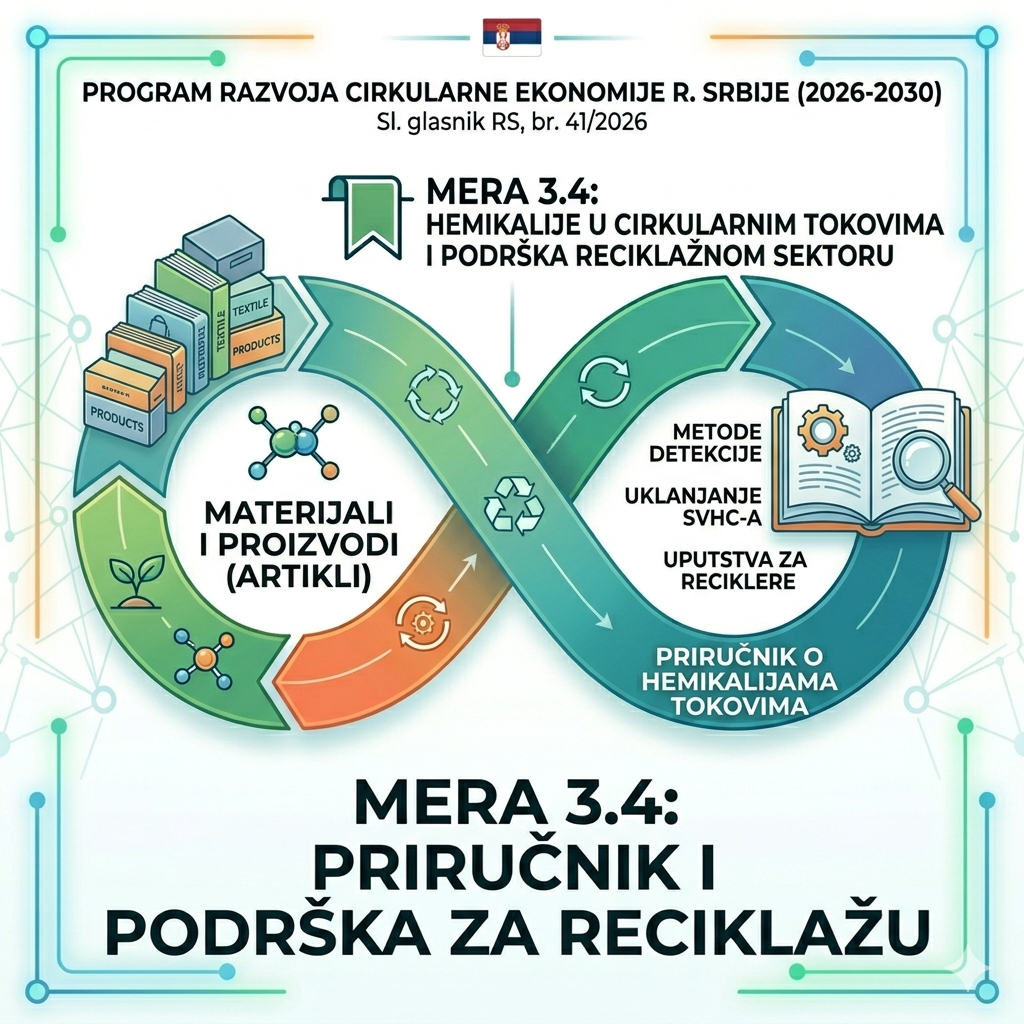
The content of the measure is concretely defined. It provides for the preparation of a handbook on chemicals that can jeopardise circular material flows and recycling processes, with methods for their detection and removal. The handbook is primarily informative and educational in nature.
Alongside the handbook, the Programme provides for workshops for the recycling sector. The plan is one workshop in 2026 and two in 2027.
Who the measure is intended for
The handbook and the workshops target the recycling sector. This is a logical choice: recycling operators are the point in the chain where there is physical contact with materials whose chemical composition is not always known.
The problem the measure addresses was described in the second article of this series. A recycling operator receiving material does not automatically have access to information on the hazardous substances that material contains. Without that information, the decision on the treatment process is made without key data. The handbook should fill part of that knowledge gap, above all in identifying the categories of chemicals that are relevant to different material flows.
Context: how the EU addresses the same problem
The EU tackled the same problem in phases. The Waste Framework Directive 2008/98/EC, as amended by Directive (EU) 2018/851, introduced the SCIP database maintained by ECHA. Since January 2021, suppliers placing articles containing SVHC substances on the EU market have been required to submit this data to ECHA. Recycling operators in the EU have access to this data through the publicly available part of the SCIP database.
SCIP is not a handbook. It is a digital register that tracks specific substances in specific articles throughout the entire life cycle, including the stage when the article becomes waste. The information in it is not generic education about categories of chemicals, but data on the presence of a specific substance in the specific material the recycler receives.
Serbia has no equivalent of the SCIP database. Measure 3.4 does not change that, nor does it claim to.
Where Measure 3.4 fits
The CE Programme 2026-2030 is a strategic document, not a legislative act. The measures in it are not binding regulations but planned activities that shape the direction of development. In that context, Measure 3.4 is a step towards raising the awareness and capacity of the recycling sector to work with chemical information.
As an instrument, a handbook has limited reach. It can explain which categories of substances are problematic and why. It cannot replace a systematic flow of information on the chemical composition of materials along the supply chain.
The Programme does not address the question of a long-term systemic solution for the flow of chemical information to the recycling sector. In theory there are two paths: developing a national digital register modelled on the SCIP database, or access to the SCIP database as part of the European integration process. Which of these two directions Serbia plans to follow cannot be seen from the Programme.
Next article in the series: the Chemicals Strategy for Sustainability (COM(2020) 667 final) and its link to the circular economy. The Digital Product Passport, as an instrument that stems from that framework, is covered in a separate series published in February.
References:
- Article 1/4: Circular Economy Programme 2026-2030 and chemicals: an introduction to the series
- Article 2/4: Chemicals and recyclability: why information on SVHC substances must arrive before waste
- Law on Chemicals
- REACH Regulation (1907/2006/EC)
- ESPR Regulation
- Chemicals Strategy for Sustainability Towards a Toxic-Free Environment
This blog post is for informational purposes only and does not constitute legal advice. For specific situations, consult a licensed chemical adviser or a lawyer specialising in chemical regulation.
← Back to blog