The Chemicals Strategy for Sustainability: the framework behind EU chemicals policy
31/05/2026 | By Ivan Milenković
When Serbia’s Circular Economy Development Programme for 2026-2030 mentions chemicals as an obstacle to circularity, it relies on concepts that did not originate in Belgrade. They originated in Brussels, in October 2020, in a document called the Chemicals Strategy for Sustainability (COM(2020) 667 final). That document is the strategic framework that explains why the EU has been doing what it does on chemicals for five years now, and why it will keep going down that path.
What the CSS is and where it comes from
The CSS is neither a regulation nor a directive. It is a Communication from the European Commission addressed to the Parliament, the Council and the EU’s economic and social bodies. As such, it does not create direct legal obligations. It sets out a vision and defines the direction of the legislative changes that follow.
The document is part of the European Green Deal and is directly linked to the Circular Economy Action Plan adopted the same year. The starting premise is simple: the chemical industry is at the same time part of the problem and part of the solution. Without safe and sustainable chemicals there is no green transition. But without regulation of hazardous chemicals there is no circular economy either.
Three concepts that define the CSS
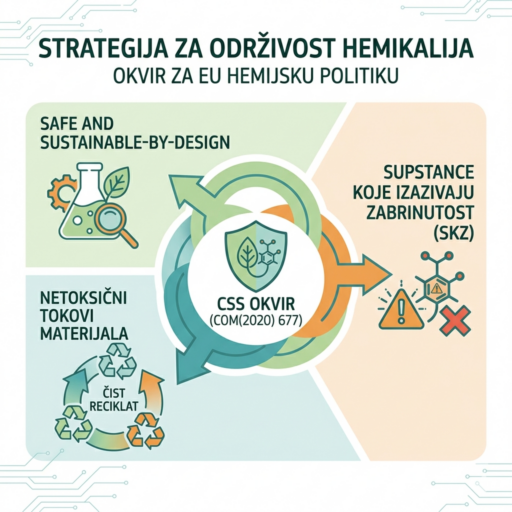
Safe and sustainable-by-design. The CSS introduces the principle that chemicals, materials and products should be designed to be safe and sustainable from the very start, not merely pass regulatory thresholds at the end of the process. This principle changes the logic: instead of the hazard being identified after the fact, it is eliminated at the design stage. The Commission planned to develop EU criteria for the SSD approach and to set up a network to support companies in the transition.
Non-toxic material cycles. The CSS states explicitly that a clean circular economy requires primary and secondary materials to always be safe. This is a direct link to the problem we described in earlier articles in this series: the presence of SVHC substances in materials blocks safe recycling. The CSS defines the goal, non-toxic material cycles, as a precondition for a functioning CE. The SCIP database is one of the instruments that follow from that goal.
Substances of concern as a separate category. The CSS introduces the notion of “substances of concern” as a broader category than the SVHC list. It covers substances that have chronic effects on health and the environment, even when they do not meet the formal SVHC criteria. The aim is to minimise and substitute these substances in consumer products, and to restrict the most hazardous ones to essential uses.
The CSS and the Serbian regulatory context
The CSS is not binding on Serbia. But Serbia is harmonising its legislation with the EU as part of the accession process, and the CSS is the framework that shapes the direction of that harmonisation. The Law on Chemicals, the SKIZ list, the Candidate List for SKIZ, the Rulebook on safety data sheets: all of these instruments follow a logic that the CSS articulates as a strategic goal.
Serbia’s CE Programme 2026-2030 cites the CSS as part of its reference framework. That is not a formality. It means that the Serbian strategy recognises the same principles as its starting point, even where the implementing instruments lag behind the EU standard.
What has been delivered from the CSS action plan
Annex I of the CSS document contains a list of concrete actions with deadlines for the period 2020-2024. Some of these actions have been delivered: the ESPR Regulation (EU) 2024/1781, which introduces the Digital Product Passport, the revision of the CLP Regulation, and the strengthening of the SCIP database. Others are delayed or have been revised in light of geopolitical changes and industrial pressure after 2022.
As a strategic document, the CSS does not expire. The principles it sets out are the basis for the legislation still to come. Companies that understand the CSS understand why EU regulation looks the way it does and where it is heading.
This article closes the series on chemicals in Serbia’s Circular Economy Programme 2026-2030. The series covered four areas: chemicals as an obstacle to circularity, SVHC obligations and the SCIP database, Measure 3.4, and the CSS as a strategic framework.
Which of these topics seems like a priority to you for a deeper dive? Send us a message.
References:
- Article 1/4: The Circular Economy Programme 2026-2030 and chemicals: introduction to the series
- Article 2/4: Chemicals and recyclability: why information on SVHC substances must arrive before the waste does
- Article 3/4: Measure 3.4: a handbook on chemicals in circular material flows
- Law on Chemicals (Serbia)
- REACH Regulation (EC) No 1907/2006
- ESPR Regulation
- Chemicals Strategy for Sustainability Towards a Toxic-Free Environment
This blog post is for informational purposes only and does not constitute legal advice. For specific situations, consult a licensed chemical adviser or a lawyer specialising in chemical regulation.
← Back to blog